Fully funded pathway to ~500koz production base
PERTH, Western Australia, Sept. 9, 2026 /CNW/ -- Westgold Resources Limited (ASX: WGX) (TSX: WGX) – Westgold or the Company) is pleased to provide its FY27 Guidance and updated Three-Year Outlook (3YO or Outlook or Updated 3YO).
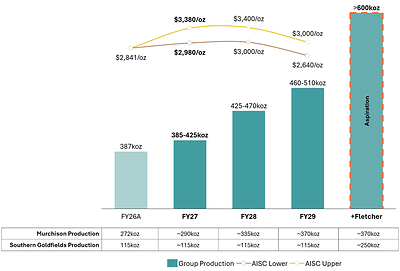
Westgold's updated Three-Year Outlook presents a fully funded organic growth plan to increase Group gold production from 385–425koz in FY27 to 460–510koz in FY29. The plan is underpinned by increased Murchison ore availability, expansion of the Cue and Meekatharra processing hubs and investment in Westgold's largest mines. This investment is expected to lift production, improve mill utilisation and reduce AISC to A$2,640–A$3,000/oz by FY29 on an FY27 real-cost basis.
The 3YO represents a deliverable base case while preserving material upside from opportunities not yet included in the Outlook. The Fletcher Zone at Beta Hunt is the largest organic growth opportunity within Westgold's portfolio and is not included in this 3YO. Once developed, and supported by a larger Southern Goldfields processing hub, current internal conceptual studies indicate Fletcher could add approximately 140kozpa to Group production and position Westgold to deliver more than 600,000ozpa1 (see Figure 1).
____________________________________ |
1 This is an aspirational statement and not a warranty as Westgold does not yet have reasonable grounds to conclude that the statement can be achieved. |
Highlights
| FY27 Guidance - Production guidance of 385-425koz – at an All-In Sustaining Cost (AISC) of $2,980-$3,380/oz2.
- Growth capital of $450M-$480M3 – investing in accelerated underground development across Westgold's largest underground mines, open pits and brownfield plant expansions at Cue and Meekatharra.
- Exploration and resource definition drilling investment of $50M-$75M3 – focused on continued Resource conversion to Reserve and Resource extension across the Murchison and Southern Goldfields.
|
| Three-Year Outlook (3YO) - FY29 production increasing to 460-510koz - underpinned by optimisation and expansion of Westgold's largest mines and Murchison processing hubs.
- FY29 AISC reducing to $2,640-$3,000/oz - driven by increasing Murchison ore optionality and mill throughput
- Group processing capacity to increase to >7Mtpa by FY29 - through sequenced brownfield expansion of the Cue (FY27), then Meekatharra (FY28) hubs.
- > $150M invested into exploration and Resource definition across the 3YO.
- Upside opportunities to bring value forward into the 3YO include:
- the Polar Star lode at Bluebird-South Junction underground mine
- Big Bell South and Paddy's Flat North open pits in the Murchison; and
- early Fletcher Zone works at Beta Hunt in the Southern Goldfields.
|
__________________________________ |
2 Third party ounces and costs are excluded from $/oz calculations |
3 This reflects the current intentions of the Company and is subject to operational priorities, market conditions and Board approval. Accordingly, this planned investment may be subject to change. |
Cautionary Statements
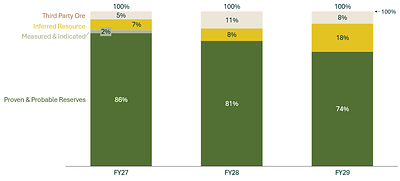
The Production Target and associated forecast financial information contained in this announcement are based on Westgold's current mine plans and comprise approximately 86% Ore Reserves, 2% Measured and Indicated Resource, 7% Inferred and 5% Third Party in FY27. 81% Ore Reserves, 8% Inferred and 11% Third Party in FY28. 74% Ore Reserves, 18% Inferred and 8% Third Party in FY29.
The Company considers that it has a reasonable basis for the Production Target and forecast financial information. The Production Target is predominantly supported by Ore Reserves throughout the outlook period. However, Mineral Resources included within the Production Target do not have the same level of confidence as Ore Reserves and there is no certainty that further work will result in their conversion to Ore Reserves or that the Production Target itself will be realised.
Where the Production Target includes Inferred Mineral Resources, there is a lower level of geological confidence associated with those tonnes and there is no certainty that further exploration work will result in the determination of Indicated Mineral Resources or that the Production Target will be achieved.
The Ore Reserve and Mineral Resource estimates underpinning the Production Target are those reported in Westgold's 2026 Mineral Resource and Ore Reserve Statement. The Company confirms that all material assumptions and technical parameters underpinning those estimates continue to apply and have not materially changed.
Westgold Managing Director and CEO Wayne Bramwell commented:
"Westgold's updated 3YO is a high confidence, executable organic growth plan lifting Group production towards 500,000 oz in FY29. This plan is fully funded with Group All-In Sustaining costs forecast to fall as the benefits of higher-grade ore availability and expansion of key Murchison mines and processing capacity to >7Mtpa are realised, delivering enhanced Group cashflow.
The capital program reflects a deliberate decision to prioritise Murchison investment and utilise Westgold's strong balance sheet, improving reserve confidence and growing mining inventories to invest ahead of production. FY27 represents the peak investment year in the 3YO, with elevated non-sustaining capital directed to accelerated underground development, strategic ore inventories and the brownfield expansions of the Cue and Meekatharra processing hubs.
Scale is not our primary driver. As these projects are delivered, annual non-sustaining capital is expected to decline through FY28 and FY29, with the benefits of these investments realised through higher production, improved mill utilisation, lower unit costs and stronger Group free cash flow.
The Beta Hunt mine is the key growth driver in the Southern Goldfields and beyond the 3YO, the Fletcher Zone within Beta Hunt provides a potential pathway to lift Group production beyond 600,000 ounces per annum. Drilling continues to increase Fletcher's scale, while development studies will assess the optimum extraction method to maximise its value.
Importantly, Westgold's growth is organic and not coming at the expense of shareholder returns. Our business is now more resilient and has the capacity to internally fund growth while continuing to support our Shareholder Capital Returns Policy4, dividends and ongoing capital returns."
_____________________________________ |
4 Refer to the Company's ASX announcement titled "Westgold delivers $122M in FY26 Shareholder Capital Returns" dated 28 August 2026 for further information regarding the Company Shareholder Capital Returns policy. |
3YO underpinned by Westgold's streamlined portfolio
Guidance and 3YO Overview
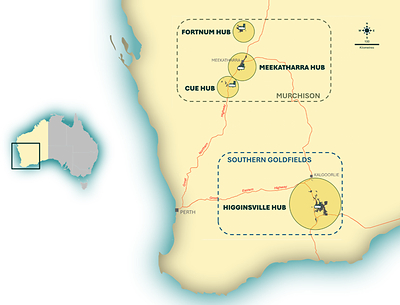
Westgold (ASX/TSX: WGX) is an unhedged, well-funded Australian gold producer with an extensive portfolio of operating assets in the Murchison and Southern Goldfields of Western Australia (Figure 2).
Westgold forecasts FY27 gold production of 385-425koz at an AISC of $2,980-$3,380/oz.
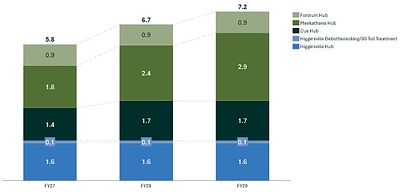
The production profile is underpinned by Westgold's four operating processing hubs with 5.8Mtpa of installed processing capacity. Growth over the outlook period is expected to be delivered through increasing utilisation of existing capital infrastructure, higher mine outputs, planned processing expansions and reduced processing of lower-grade stockpile material.
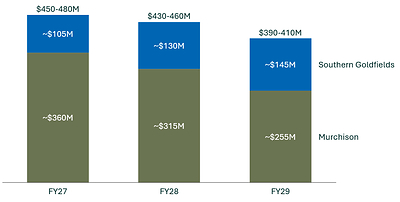
Organic growth will be underpinned by $450M-$480M of capital investment and $50M-$75M of exploration and resource definition expenditure in FY273.
The Company's 3YO foundation is the 2026 Mineral Resource Estimate and Ore Reserves5. It defines a high confidence, executable plan to grow gold production from 385-425koz in FY27 to 460-510kozpa by FY29, at a competitive all in sustaining cost of $2,640 – $3,000/oz (Table 1).
The 3YO outlines how increasing Group outputs, free cash flows and operating margins will be delivered and is premised upon fully utilising our existing extensive processing infrastructure, increased mine outputs at specific operations and expansions to key processing assets over the 3YO period.
______________________________ |
5 Refer to the Company's ASX announcement titled "2026 Mineral Resource Estimate and Ore Reserves" dated 20 August 2026 for further information. |
Table 12: Westgold's 3YO |
Metric | Guidance | Outlook |
FY27 | FY28 | FY29 |
Gold Production (koz) | 385 - 425 | 425-470 | 460-510 |
AISC ($/oz) | 2,980 - 3,380 | 3,000-3,400 | 2,640-3,000 |
Non-Sustaining Capex ($M) | 450 – 480 | 430-460 | 390-410 |
Exploration & Resource Definition ($M) | 50 - 75 | 50-75 | 50-75 |
Key assumptions and strategic updates to the FY26 3YO
FY26 was a defining year in the execution of Westgold's original Three-Year Outlook6 (FY26 3YO). The corporate strategy to focus on our largest assets delivered and Westgold achieved record gold production, exceeded annual production guidance, materially increased Ore Reserves, improved Mineral Resource quality and strengthened confidence in long-term mine plans across the portfolio.
These outcomes, together with record operating cash flow and improved geological understanding, have given Westgold the confidence to accelerate development, prioritise the highest-value growth opportunities and refine its long-term growth strategy. The updated FY27 3YO builds on those achievements with the key strategic changes from FY26 3YO outlined below.
- Accelerating Murchison growth
The most significant change in this 3YO is the increased focus on growth across the Murchison.
The FY26 3YO identified the Murchison Open Pit Program, Bluebird-South Junction expansion, Great Fingall ramp-up and processing optimisation as key drivers of future Murchison production growth. Westgold has since advanced each initiative while continuing to grow Ore Reserves and improve mine plan confidence.
Ore inventories are expected to grow across the Murchison over the updated 3YO period. In response, Westgold has progressed engineering and development plans for both the Cue Expansion Project (CXP)7 and Meekatharra Expansion Project (MXP)8, both of which are now included in the FY27 3YO.
Together, these projects increase Murchison processing capacity by approximately 1.4Mtpa, lifting total Murchison capacity to approximately 5.5Mtpa over the 3YO, and provide the most direct pathway to higher production, improved mill utilisation and lower unit costs. Capital allocation has therefore been prioritised towards the Murchison and accelerated over the 3YO period to support the associated mining and milling expansion.
____________________________ |
6 Refer to ASX announcement titled "Westgold Provides 3-Year Outlook" dated 1 October 2025. |
7 Refer to the Company's ASX announcement titled "Cue Hub Expansion to 1.7Mtpa in FY28" dated 5 August 2026. |
8 Refer to the Company's ASX announcement titled "2.9Mtpa Meekatharra Expansion Plan" dated 25 August 2026. |
- Fletcher growth drives a revised Southern Goldfields strategy
The updated 3YO also reflects a reassessment of the preferred growth pathway for the Southern Goldfields.
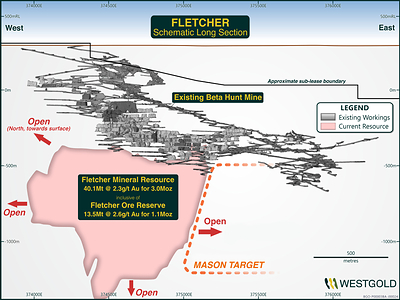
The FY26 3YO contemplated a staged expansion of the Higginsville processing hub from 1.6Mtpa to 2.6Mtpa through the Higginsville Expansion Project (HXP)9. Since then, ongoing drilling at Fletcher has resulted in the declaration of a maiden Ore Reserve of 13.5Mt at 2.6g/t Au for 1.1Moz and an updated Mineral Resource of 40.1Mt at 2.3g/t Au for 3.0Moz10, materially increasing the scale of the opportunity and changing the preferred long-term development pathway.
As a result, Westgold has deferred inclusion of the HXP in the current 3YO while it evaluates a larger long-term growth solution centred on Fletcher.
Current studies assess a potential 4Mtpa processing hub, alternative haulage solutions and the optimal development strategy for the broader Southern Goldfields. As these options remain under evaluation, Fletcher and its associated capital requirements have been excluded from the 3YO and are presented as upside to the Outlook.
- Murchison Open Pit Program delivering ahead of schedule
The Murchison Open Pit Program was one of the key strategic initiatives identified in the FY26 3YO. Supported by strong operating cash flow, growing Ore Reserves and improved mine plan confidence, Westgold commenced the program approximately three months ahead of schedule during Q4 FY2611.
The program is more than an additional ore source. It establishes strategic ore inventories ahead of the Meekatharra and Cue processing hubs, reducing reliance on stockpile haulage, improving operating flexibility and supporting more consistent production.
These inventories also strengthen the economic rationale for MXP and CXP and provide the foundation for increased Murchison throughput over the 3YO.
|
|
|
|
9 Refer to the Company's ASX announcement titled "Board Approves Higginsville Expansion Plan" dated 10 March 2026. |
10 Refer to the Company's ASX announcement titled "1.1Moz Maiden Fletcher Ore Reserve" dated 18 August 2026. |
11 Refer to the Company's ASX announcement titled " June 2026 Quarterly Results" dated 22 July 2026. |
- Improved Resource quality increases confidence in the Outlook
During FY26, Westgold increased Group Ore Reserves by 41% to 4.1Moz5, after adjusting for asset sales. Improved Measured and Indicated Resource confidence, accelerated underground development and sustained investment in exploration and resource definition have expanded mining inventories, reduced geological uncertainty and improved confidence in future production outcomes.
This provides a stronger foundation for the updated 3YO and as such the updated 3YO is more than a revised production forecast. It reflects the successful delivery of the FY26 plan and leverages a stronger asset base, higher-quality Ore Reserves and improved mine plan confidence across the portfolio.
- Additional key assumptions
Cost and production forecasts are based on current operating metrics across the business. Capital cost assumptions are derived from completed studies unless otherwise stated. Mining productivity assumptions are applied consistently across the mine plans, providing a conservative baseline with the potential for operational outperformance.
The result is a fully funded, executable 3YO designed to deliver higher production, lower unit costs and a stronger platform for long-term organic growth and free cashflow.
Gold Production across the 3YO
Westgold forecasts gold production of 385-425koz in FY27, increasing to 425-470koz in FY28 and 460-510koz in FY29.
Production growth is driven by Westgold's streamlined operating portfolio and expanded processing infrastructure, with higher outputs expected from increased mill utilisation, ore availability and continued development of key Murchison mining fronts.
The 3YO assumes ongoing optimisation of Westgold's four processing hubs, with installed capacity increasing from approximately 5.8Mtpa in FY27 to 7.2Mtpa by FY29 through the CXP and MXP (see Figure 3).
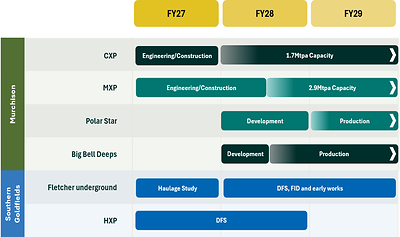
The key growth projects and their delivery timings are depicted below in Figure 4.
Murchison
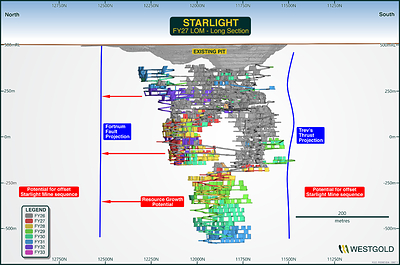
Fortnum is expected to deliver steady mine and mill performance across the Outlook, supported by a balanced underground mine plan (see Figure 5) and processing profile.
Open pit mining at Fortnum is planned across FY28 and FY29 as part of the Murchison Open Pit Program and development of the long-term tailings storage facility. The activity generates mill feed inventory while enabling critical infrastructure development, reducing execution risk and preserving long-term production continuity.
Westgold has assumed no third-party ore is processed at Fortnum in the 3YO.
A scoping study assessing expansion of the Fortnum hub to 1.5Mtpa was completed in December 2024. Plant debottlenecking has since lifted throughput towards approximately 1Mtpa during 2026, providing operating data to inform future expansion decisions.
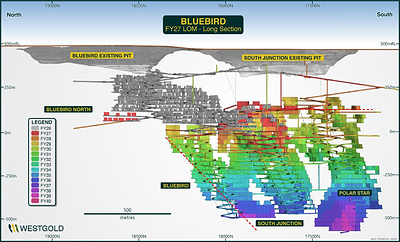
Meekatharra growth is driven primarily by higher output from Bluebird-South Junction (see Figure 6), the hub's main ore source. Bluebird-South Junction achieved a 1Mtpa mining rate in June 2026, with rates expected to increase to 1.2Mtpa during FY27 from two mining fronts (Bluebird and South Junction).
This increased production is expected to displace lower-grade stockpile material previously hauled from Cue.
Polar Star – the third mining front within Bluebird-South Junction.
A new portal developed in FY26 provides access for diamond drilling to expand the Mineral Resource and increase mine plan confidence. Given Polar Star's proximity to the existing South Junction mine plan, production could be introduced from a third mining front relatively quickly once drilling, planning and development is sufficiently advanced.
The current schedule assumes Polar Star commences in FY28 and ramps up to contribute approximately 500ktpa additional mine output from FY29, subject to drilling outcomes, mine planning and delivery of the required development.
The Murchison Open Pit Program, which commenced around three months ahead of schedule in Q4 FY26, is already supplying higher-grade open pit ore to Meekatharra. This reduces reliance on lower-grade stockpiles and long-distance haulage, builds strategic ore inventories ahead of the mill and supports more consistent production, greater operating flexibility and higher utilisation of the Meekatharra processing hub.
The 3YO assumes third-party ore purchase agreements contribute approximately 30koz in FY27, 70koz in FY28 and 40koz in FY29.
Growing ore inventories from increasing mine production near the hub underpin the MXP, which will expand processing capacity from 1.8Mtpa to 2.9Mtpa by mid-FY28. Engineering and construction are expected to take approximately 18 months.
The development concept utilises equipment already procured for the Higginsville expansion, improving capital efficiency and potential MXP throughput.
Cue Hub growth is expected to be driven by increased Great Fingall ore, which will progressively replace lower-grade Big Bell feed. Great Fingall is forecast to ramp steadily to 40kt per month, with grades improving following access to virgin stopes at Golden Crown and the Great Fingall reef in Q4 FY26.
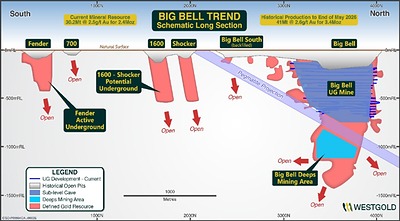
At Big Bell, the mine plan progressively shifts from transverse mining in the upper cave toward the virgin Big Bell Deeps area (see Figure 7). Big Bell Deeps is expected to deliver ore from FY28, creating the potential for a second higher-grade ore source at the Cue hub.
Subject to upper-cave performance, Westgold may be able to operate two distinct mining areas, with Big Bell Deeps contributing grade and the existing cave contributing volume. This configuration would improve flexibility in balancing feed grade, production rate and sequencing.
The current study basis contemplates Big Bell Deeps being mined using longhole open stoping with paste fill. Most key supporting infrastructure, including paste plants and reticulation, has already been procured.
The preferred mining method remains subject to ongoing studies, with a final decision scheduled for H2 FY27.
Increasing production from Big Bell and Great Fingall underpins the CXP, a capital-light expansion of Cue processing capacity from 1.4Mtpa to 1.7Mtpa. The 3YO assumes expanded capacity becomes available in late FY27, with long-lead items already procured.
Independent analysis has confirmed CXP's project economics and proposed implementation strategy. Delivery remains subject to execution against the approved scope, schedule and capital plan.
Southern Goldfields
Southern Goldfields production is expected to remain broadly stable through the 3YO, with Beta Hunt continuing as the key ore source for the Higginsville processing hub.
The 3YO prioritises profitability, productivity and future growth options while maintaining consistent mill feed to Higginsville. Beta Hunt provides stable ore supply, supporting efficient use of existing infrastructure and a predictable Southern Goldfields production profile.
Beta Hunt grades are expected to moderate as the mine plan shifts toward a greater contribution from bulk mining methods. While this is expected to modestly reduce delivered grade, the selected mining approach should improve productivity, reduce development intensity and lower unit mining costs, supporting stronger overall mining economics and a more sustainable long-term production profile.
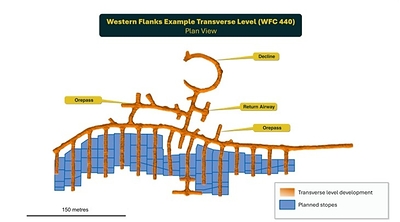
Development completed in FY26 supports the implementation of a transverse primary and secondary mining sequence in FY27 (see Figure 8). The layout separates production into northern and southern mining districts, improving operating flexibility, traffic flow and interaction between mining activities.
The 3YO assumes the Lakewood tolling agreement ends in FY27. From FY28, the 3YO assumes a further tolling solution of approximately 100ktpa or an equivalent processing improvement through Higginsville debottlenecking.
The 3YO uses the existing Beta Hunt mine inventory and excludes any contribution from the emerging Fletcher Zone or continued production from Two Boys. Fletcher remains a significant long-term Southern Goldfields growth opportunity, while Two Boys continues to produce in FY27 as drilling assesses potential mine-life extensions.
AISC
FY27 AISC guidance is A$2,980-A$3,380/oz2.
The FY27 cost profile reflects ongoing inflation in labour, energy and consumables, higher royalties in a stronger Australian dollar gold price environment, increased Murchison open pit mining and lower forecast grades in the Southern Goldfields.
This cost profile should be viewed in the context of Westgold's broader optimisation strategy. The Company is investing in mine development, ore inventories and operating flexibility to build a more resilient production platform and lift utilisation of existing processing infrastructure.
Key initiatives include building strategic ore inventories from the Murchison Open Pit Program and accelerated underground development across priority mining centres.
On a FY27 real cost basis, Westgold expects AISC to reduce to A$2,640-A$3,000/oz by FY29.
The expected improvement is driven by higher-grade ore feed at key hubs, reduced reliance on lower-grade stockpiles and increased contribution from established mining fronts, including Bluebird-South Junction, Polar Star, Great Fingall and Big Bell Deeps.
Lower unit costs are also expected from greater operating flexibility delivered by the Murchison Open Pit Program and expanded processing capacity at the Meekatharra and Cue hubs.
Non-Sustaining Capital
Westgold expects FY27 non-sustaining capital expenditure of $450M-$480M3.
This reflects a deliberate strategy to accelerate mine development, expand processing capacity and build mining inventory ahead of production. Continued investment in drilling, resource definition and mine planning has improved confidence in the Outlook and supports more consistent production across Westgold's four processing hubs.
A significant proportion of capital over the 3YO is directed to the Murchison (see Figure 9), reflecting growing ore inventories, higher mine output and increased use of existing processing infrastructure. Growth from Bluebird-South Junction, Great Fingall, Big Bell and the Murchison Open Pit Program is creating the need for additional milling capacity and supporting infrastructure.
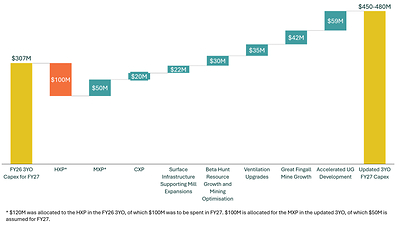
Accordingly, the 3YO includes both the MXP and CXP. The 3YO assumes FY27 spend of $20M for CXP and assumes at total of $100M for MXP, split evenly across FY27 and FY28.
Together, these projects increase Group milling capacity from approximately 5.8Mtpa in FY27 to 7.2Mtpa by FY29.
Much of the FY27 and FY28 investment is directed toward future production fronts rather than sustaining current operations. This includes development at Bluebird-South Junction and advancing the Polar Star and Big Bell Deeps mining areas, which are expected to support production growth and longer-life mining centres beyond the current 3YO.
The Outlook assumes $80M of development capital for Polar Star across FY28 and FY29 and $110M for Big Bell Deeps over the same period. The capital profile peaks in FY27 and declines through the remainder of the 3YO as major development activities, MXP and CXP progress towards completion.
As these projects are delivered, Westgold expects higher production, lower unit costs and stronger free cash flow generation.
While 3YO capital allocation is focused on the Murchison, the Southern Goldfields remains strategically important. The maiden Ore Reserve and updated Mineral Resource at Fletcher have changed the preferred long-term development pathway, prompting reassessment of the Higginsville expansion strategy. Fletcher and its associated capital requirements are therefore excluded from the 3YO while haulage, processing and development studies are completed.
Future growth capital is expected to shift increasingly toward the Southern Goldfields once the preferred Fletcher development pathway is established.
The 3YO capital program underpins production during the 3YO period while establishing the mining fronts expected to drive growth beyond FY29.
Figure 10 below shows the key movements between Non-Sustaining Capital Expenditure forecast in the FY26 3YO for FY27 against the Non-Sustaining Capital Expenditure within the FY27 Guidance.
The key capital movements from the FY26 3YO to the updated 3YO are summarised below:
- Murchison Expansion Projects (MXP and CXP)
Growing ore inventories in the Murchison have prioritised the expansion of the Cue and Meekatharra capital towards MXP and CXP. These projects provide additional capacity to process increasing Murchison ore inventories and mine output.
- Beta Hunt Resource Growth and Mining Optimisation
Enhanced bulk-stoping methods implemented across A Zone and Western Flanks at Beta Hunt in FY26 have identified opportunities beyond the current two-year production horizon. A triple-lift approach could materially reduce development metres per stope tonne, improve efficiency and lower operating costs.
Additional diamond drilling has been included in the 3YO to support this opportunity.
Westgold has brought forward several primary ventilation upgrades across its underground operations. These projects are expected to support earlier expansion of mining activity, improve energy efficiency and enable additional underground equipment to be deployed sooner.
- Larger Great Fingall mine design has deferred commercial production
Drilling at Great Fingall and Golden Crown has improved orebody knowledge and geological confidence, supporting a larger and lower-risk mine design than the original Feasibility Study.
Underground drilling, required due to nuggety mineralisation, and further assessment of historic workings have refined the mine plan, with commercial production now expected in FY27.
- Accelerated underground development builds long-term mining consistency
Westgold's record FY26 cash position has enabled accelerated underground development ahead of current mining fronts. This capital investment builds operational buffer, improves scheduling flexibility, supports higher mill throughput where capacity exists and increases portfolio resilience.
The updated 3YO reflects Westgold's shift from stabilising a historically underinvested asset base to investing for sustainable growth. The revised capital profile prioritises infrastructure upgrades, operating efficiency and long-term organic growth across the portfolio.
Importantly, the 3YO remains fully funded and is expected to support the Company's Shareholder Capital Returns Policy, including dividends and capital returns, throughout the outlook period.
Exploration and Resource Definition
Westgold expects to invest $50-$75M in exploration and resource definition during FY27, building on its industry-leading FY26 Reserve replacement performance.
The program is focused on converting and extending the Company's 14.4Moz Mineral Resource inventory across its tenure. Westgold is currently operating seven surface rigs and 19 underground drill rigs planning to drill over 600km in FY27 across grade control, resource definition and exploration programs.
Resource definition drilling is focused on key upside areas outside the 3YO but within the broader Life of Mine plan:
- Big Bell South (Murchison)
Resource Definition drilling is currently underway along the Big Bell South targets (see Figure 7). This has been stage-gated to concentrate on the highest value opportunities, focusing on the 1600-Shocker resource. These pits were mined in the early 1990's, cutback again from 2001-2003, and produced 1.2Mt at 2.3g/t for 88koz. They sit along the 2.8Moz wider Big Bell Trend.
- Cuddingwarra Open Pits (Murchison)
Westgold continues to progress with Resource Definition throughout the Cuddingwarra area near Cue. Whilst a secondary target compared to Big Bell South, the opportunity is no less significant. Cuddingwarra has a Mineral Resource of 2.4Mt at 1.6g/t for 122koz12, with previous production of 640kt at 3.5g/t for 72koz.
- Paddy's Flat North (Murchison)
Targeting the historical Halcyon and Democrat pits (north of the underground mine) which produced 500kt at 3g/t Au for 58koz and 192kt at 3.3g/t Au for 20koz respectively. Drilling has begun in this region which has not been explored since open pit mining concluded in the 1990s.
The Paddy's Flat area has historically produced more than 1.7Moz, comprising approximately 832koz from underground operations and 877koz from open pits. Westgold is re-evaluating the Paddy's complex as a potentially large open pit operation with drilling underway in Q1, FY27.
- Mason (Beta Hunt – Southern Goldfields)
Parallel to the Larkin lode, the Mason lode is determined to be the continuation of the Fletcher orebody south of the Alpha Island Fault (see Figure 12). Drilling of Mason is currently underway which will determine the inclusion into the wider Fletcher mine plan.
___________________________________ |
12 Refer to the Company's ASX announcement titled "2026 Mineral Resource Estimate and Ore Reserves" dated 20 August 2026 for further information. |
Westgold continues to improve the quality and convertibility of its Mineral Resource inventory. Ore Reserves have increased from 3.3Moz in FY24 to 4.1Moz in FY2613, despite ongoing mining depletion, resulting in Reserve coverage increasing from 25% to 28.5% of total Mineral Resources.
This reflects the success of targeted Resource Definition drilling, geological model enhancements and mine planning across the portfolio.
Resource Confidence
Key to the delivery of the 3YO is confidence in the mine plans.
Over 80% of Westgold ore milled throughout the 3YO is within the Proven and Probable Reserve categories with an average of over 70% Proven and Probable in FY29 (see Figure 11). Business plans are aligned with increasing resource confidence over the latter half of the 3YO.
The 3YO assumes $50-75M investment each year in exploration and resource definition drilling to improve resource confidence beyond the 3YO14.
_______________________________ |
13 Refer to the Company's ASX announcement titled "2026 Mineral Resource Estimate and Ore Reserves" dated 20 August 2026 for further information. |
14 This reflects the current intentions of the Company and is subject to operational priorities, market conditions and Board approval. Accordingly, this planned investment may be subject to change. |
Fletcher Zone at Beta Hunt – Southern Goldfields Growth Driver
The 3YO intentionally excludes any production contribution from the Fletcher Zone at Beta Hunt and any associated development capital. Fletcher remains Westgold's most significant organic growth opportunity within the Beta Hunt mine complex and provides the clearest pathway to a production platform exceeding 600kozpa beyond FY29.
Recent drilling success resulted in the declaration of a 1.1Moz maiden Ore Reserve and a 3.0Moz updated Mineral Resource for Fletcher15, materially increasing confidence in the scale and continuity of the system (see Figure 12).
Importantly, drilling completed to date has only tested approximately half of the currently defined strike extent, with substantial exploration potential remaining open and ongoing drilling continuing to assess the ultimate scale of the mineralised system.
_________________________________ |
15 Refer to the Company's ASX announcement titled "1.1Moz Maiden Fletcher Ore Reserve" dated 18 August 2026. |
Current internal conceptual studies indicate Fletcher could support a third major mining front within the Southern Goldfields and add approximately 140kozpa of production at steady state. While this demonstrates the scale of the opportunity, Westgold considers it premature to incorporate Fletcher into the 3YO while key development and infrastructure decisions remain under evaluation.
Westgold is currently assessing multiple development pathways for Fletcher. The base study concept assumes a 4Mtpa processing solution at Higginsville and conventional underground haulage and trucking; however, management believes this is unlikely to represent the optimal long-term development outcome. Consequently, studies are examining alternative infrastructure solutions capable of improving operating efficiency, lowering capital intensity and accelerating development.
A key component of this work is evaluating future processing options for the Southern Goldfields. In addition to expansion of Higginsville, Westgold is assessing the potential development of a new processing facility located closer to Beta Hunt.
The Company's Spargos landholding, located approximately 30km from Beta Hunt by road, is being considered as one potential location. Compared to the current haulage distance to Higginsville of approximately 80km, a processing solution located closer to Beta Hunt could materially improve project economics through lower haulage costs and greater operating flexibility.
Based on preliminary internal analysis, a 4Mtpa processing plant located at Spargos could reduce haulage costs by approximately $10/t relative to the current Higginsville-based concept, resulting in an annualised saving of $40M.
In parallel, Westgold has commenced a dedicated mine haulage study to determine the preferred mine-to-surface ore transport solution for Fletcher. The study is assessing alternatives to conventional trucking and will form a key input into future development decisions, processing infrastructure requirements and capital allocation priorities for the Southern Goldfields.
For these reasons, Fletcher has been excluded from the 3YO as Westgold believes it is prudent to complete the current drilling, haulage and development studies before defining a preferred development pathway. While this approach delays incorporation into the formal Outlook, it preserves substantial upside beyond FY29 while retaining the flexibility to incorporate Fletcher into future outlooks as studies mature.
Additional upside to the 3YO
The 3YO depicts an executable baseline for Westgold – with upside.
The 3YO intentionally excludes several other material opportunities that have the potential to accelerate production growth, improve operating margins or extend mine life beyond the current planning horizon.
These opportunities continue to be progressed through drilling, engineering studies and technical evaluation, but have not been incorporated into the Outlook due to remaining study, permitting and investment decision requirements.
- Acceleration of Polar Star at Bluebird – South Junction mine
The current Outlook assumes Polar Star contributes approximately 500ktpa from FY29 following a measured development and drilling program. Polar Star's close proximity to the existing Bluebird-South Junction mining complex provides flexibility to accelerate development should drilling results, mine planning and infrastructure availability support an earlier production profile.
Further opportunity exists to align accelerated mining at Polar Star with incremental processing capacity available through the Meekatharra Expansion Project, potentially increasing throughput and production beyond the 3YO assumptions.
- Additional Open Pit Opportunities
The Murchison Open Pit Program currently incorporates only a portion of Westgold's broader open pit inventory. Multiple opportunities remain under evaluation, including Paddy's Flat North and Big Bell South, where drilling programs are currently underway.
In particular, Big Bell South has the potential to provide a source of higher-grade open pit material proximal to existing infrastructure. Successful drilling and study outcomes may allow Big Bell South to contribute ore ahead of, or in combination with, Big Bell Deeps, potentially deferring elements of future underground capital while extending the productive life of the existing Big Bell operation.
- Expansion of the Fortnum Mill
The 3YO assumes Fortnum remains a broadly matched underground mine and processing operation, with stable production and no processing expansion included. The 3YO establishes open pit mill-feed inventory at Fortnum during FY28 and FY29, while the existing plant remains allocated to the matched underground production profile.
A future plant expansion could accelerate processing of this open pit inventory, bringing forward production and increasing output beyond the 3YO. Westgold continues to assess expansion options for the Fortnum processing hub.
Additional capacity would also provide flexibility to process additional ore purchase agreements or further third-party milling opportunities, which are not included in the 3YO.
- Acceleration of Big Bell Deeps
The 3YO assumes Big Bell Deeps commences production from FY28 following the completion of ongoing mining method studies. Big Bell Deeps provides access to higher-grade mineralisation beneath the existing cave and has the potential to accelerate grade improvements at the Cue Hub.
Should study outcomes and mine development progress support an earlier transition into Big Bell Deeps, Westgold may be able to increase the contribution of higher-grade ore sooner than assumed in the 3YO, reducing reliance on lower-grade cave material and improving feed quality into the Cue processing hub.
No contribution from coarse gold has been incorporated into the 3YO. Any coarse gold discovery would represent further production upside.
- Extensions to Two Boys and Other Southern Goldfields Opportunities
The 3YO includes no production from Two Boys in the Southern Goldfields and Fender in the Murchison. Ongoing drilling is targeting extensions to known mineralisation at Two Boys and Fender, while both mines continue to deliver higher grade and cash generation over the first two months of FY27. Success from these drilling programs may extend mine life, improve or maintain current feed grades representing further upside to the 3YO.
- Exploration, resource conversion, ore purchase or toll treating opportunities
The 3YO envisages mining only resources within Westgold's current asset package and land holding. No allowances have been made for further exploration discovery, resource conversion or production upside through new business development opportunities outside existing ore purchase agreements.
Conclusion
Westgold's updated 3YO establishes a fully funded and executable pathway to grow production from FY27 guidance of 385-425koz to 460-510koz by FY29 while improving operating margins through increased ore availability, mill utilisation and a lower cost profile.
The 3YO is underpinned by Westgold's existing operating portfolio, four processing hubs and its current Ore Reserve and Mineral Resource base, providing a high-confidence foundation for delivery over the next three years.
Importantly, the 3YO intentionally excludes any production contribution from the Fletcher Zone at Beta Hunt. Fletcher represents one of the largest organic growth opportunities within Westgold's portfolio and, based on current internal studies, provides a pathway to add approximately 140kozpa of production and establish a production platform capable of exceeding 600kozpa.
While substantial study work remains to be completed, including optimisation of the development strategy, haulage solution and ultimate processing configuration, Westgold believes it is prudent to exclude Fletcher from the base case until those studies are further advanced.
The 3YO reflects what the Company can confidently deliver from its existing portfolio while preserving significant future upside from Fletcher.
Beyond Fletcher, additional opportunities exist through acceleration of Polar Star and Big Bell Deeps, expansion of the Fortnum processing hub, further open pit developments and extensions to existing mining areas, none of which are required to achieve the 3YO presented in this announcement.
The investments outlined in the 3YO not only underpin production within the 3YO period but establish the mining fronts expected to drive production well beyond FY29. Through continued investment in mine development, reserve conversion and strategic infrastructure, Westgold is building the foundations for a sustainably larger gold business capable of generating stronger cash flow, greater operational flexibility and long-term shareholder value.
Westgold Update Webcast
Wayne Bramwell (Managing Director & CEO), Tommy Heng (Chief Financial Officer) Aaron Rankine (Chief Operating Officer), and Leigh Devlin (Chief Technical Officer) will present an update on the 3YO via webcast on Wednesday, 9 September 2026 at 10:00AM AWST / 12:00PM AEST, followed by a Q&A session.
To listen to the Webcast live, please click on the link below and register your details, or cut and paste the URL into your web browser:
WESTGOLD FY27 GUIDANCE AND 3 YEAR OUTLOOK WEBINAR
https://attendee.gotowebinar.com/register/2704967287087160919
After registering, you will receive a confirmation email containing information about joining the webinar. Please log on a few minutes before the scheduled commencement time to ensure you are registered in time for the start of the call.
This announcement is authorised for release to the ASX by the Board.
Compliance Statements
The information in this release that relates to the Ore Reserves and Mineral Resources of Westgold has been extracted from the ASX announcement titled "2026 Mineral Resource Estimate and Ore Reserves" released to the ASX on 20 August 2026 and available at www.asx.com.au. Westgold confirms that it is not aware of any new information or data that materially affects the information included in that announcement, and that all material assumptions and technical parameters underpinning the estimates in that announcement continue to apply and have not materially changed. Westgold confirms that the form and context in which the Competent Persons findings are presented have not been materially modified from that announcement.
Competent/Qualified Person Statements
Exploration Results and Mineral Resources Estimates
The information in this release that relates to Exploration results and Mineral Resource Estimates is compiled by Westgold technical employees and contractors under the supervision of Mr. Jake Russell B.Sc. (Hons), who is a member of the Australian Institute of Geoscientists and who has verified, reviewed and approved such information. Mr Russell is a full-time employee of the Company and has sufficient experience which is relevant to the styles of mineralisation and types of deposit under consideration and to the activities which he is undertaking to qualify as a Competent Person as defined in the 2012 Edition of the Australasian Code for Reporting of Exploration Results, Mineral Resources and Ore Reserves (the "JORC Code") and as a Qualified Person as defined in the CIM Guidelines and National Instrument 43-101 – Standards of Disclosure for Mineral Projects ("NI 43-101"). Mr. Russell is an employee of the Company and, accordingly, is not independent for purposes of NI 43-101. Mr Russell consents to and approves the inclusion in this release of the matters based on his information in the form and context in which it appears. Mr Russell is eligible to participate in short- and long-term incentive plans of the company.
The Mineral Resource Estimates contained herein have an effective date of 30 June 2026 and were completed by Westgold technical employees and contractors under the supervision of Mr Jake Russell. The key inputs and assumptions are provided in Appendix A to this release including Section 1 – Sampling Techniques and Data, Section 2 – Reporting of Exploration Results, Section 3 – Estimation and Reporting of Mineral Resources and Section 4 – Estimation and Reporting of Ore Reserves.
Ore Reserves
The information in this release that relates to Ore Reserve is based on information compiled by Mr. Leigh Devlin B.Eng. FAusIMM, who has verified, reviewed and approved such information. Mr. Devlin has sufficient experience which is relevant to the styles of mineralisation and types of deposit under consideration and to the activities which they are undertaking to qualify as a Competent Person as defined in the JORC Code and as a Qualified Person as defined in the CIM Guidelines and NI 43-101. Mr. Devlin is an employee of the Company and, accordingly, is not independent for purposes of NI 43-101. Mr. Devlin consents to and approves the inclusion in this release of the matters based on his information in the form and context in which it appears. Mr. Devlin is a full-time senior executive of the Company and is eligible to and may participate in short-term and long-term incentive plans of the Company as disclosed in its annual reports and disclosure documents.
General
Mineral Resources, Ore Reserve Estimates and Exploration Targets and Results are calculated in accordance with the JORC Code. Investors outside Australia should note that while Ore Reserve and Mineral Resource estimates of the Company in this announcement comply with the JORC Code (such JORC Code-compliant Ore Reserves and Mineral Resources being "Ore Reserves" and "Mineral Resources" respectively), they may not comply with the relevant guidelines in other countries.
The JORC Code is an acceptable foreign code under NI 43-101. Information contained in this release describing mineral deposits may not be comparable to similar information made public by companies subject to the reporting and disclosure requirements of US securities laws, including Item 1300 of Regulation S-K. All technical and scientific information in this release has been prepared in accordance with the Canadian regulatory requirements set out in NI 43-101 and has been reviewed on behalf of the Company by Qualified Persons, as set forth above.
This release contains references to estimates of Mineral Resources and Ore Reserves.
The estimation of Mineral Resources is inherently uncertain and involves subjective judgments about many relevant factors. Mineral Resources that are not Ore Reserves do not have demonstrated economic viability. The accuracy of any such estimates is a function of the quantity and quality of available data, and of the assumptions made and judgments used in engineering and geological interpretation, which may prove to be unreliable and depend, to a certain extent, upon the analysis of drilling results and statistical inferences that may ultimately prove to be inaccurate. Mineral Resource estimates may require re-estimation based on, among other things: (i) fluctuations in the price of gold; (ii) results of drilling; (iii) results of metallurgical testing, process and other studies; (iv) changes to proposed mine plans; (v) the evaluation of mine plans subsequent to the date of any estimates; and (vi) the possible failure to receive required permits, approvals and licenses.
Forward Looking Statements
These materials prepared by Westgold include forward looking statements. Often, but not always, forward looking statements can generally be identified by the use of forward looking words such as "may", "will", "expect", "intend", "believe", "forecast", "predict", "plan", "estimate", "anticipate", "continue", and "guidance", or other similar words and may include, without limitation, statements regarding the Company's 3YO, including estimates of gold production, grades, recoveries and its expectations regarding AISC, the timing of updates to Mineral Resource estimates or Ore Reserves, plans, strategies and objectives of management, anticipated production or construction commencement dates and expected costs or production outputs.
Forward looking statements inherently involve known and unknown risks, uncertainties and other factors that may cause the Company's actual results, performance and achievements to differ materially from any future results, performance or achievements. Relevant factors may include, but are not limited to, changes in commodity prices, foreign exchange fluctuations and general economic conditions, increased costs and demand for production inputs, the speculative nature of exploration and project development, including the risks of obtaining necessary licenses and permits and diminishing quantities or grades of reserves, political and social risks, changes to the regulatory framework within which the Company operates or may in the future operate, environmental conditions including extreme weather conditions, recruitment and retention of personnel, industrial relations issues and litigation.
Forward looking statements are based on the Company and its management's good faith assumptions relating to the financial, market, regulatory and other relevant environments that will exist and affect the Company's business and operations in the future. The Company does not give any assurance that the assumptions on which forward looking statements are based will prove to be correct, or that the Company's business or operations will not be affected in any material manner by these or other factors not foreseen or foreseeable by the Company or management or beyond the Company's control.
Although the Company attempts and has attempted to identify factors that would cause actual actions, events or results to differ materially from those disclosed in forward looking statements, there may be other factors that could cause actual results, performance, achievements or events not to be as anticipated, estimated or intended, and many events are beyond the reasonable control of the Company.
In addition, the Company's actual results could differ materially from those anticipated in these forward-looking statements as a result of the factors outlined in the "Risk Factors" section of the Company's continuous disclosure filings available on SEDAR+ or the ASX, including, in the Company's current annual report, half year report or most recent management discussion and analysis.
Accordingly, readers are cautioned not to place undue reliance on forward looking statements. Forward looking statements in these materials speak only at the date of issue. Subject to any continuing obligations under applicable law or any relevant stock exchange listing rules, in providing this information the Company does not undertake any obligation to publicly update or revise any of the forward-looking statements or to advise of any change in events, conditions or circumstances.
Appendix A – JORC 2012 Table 1– Gold Division
SECTION 1: SAMPLING TECHNIQUES AND DATA
(Criteria in this section apply to all succeeding sections.)
Criteria | JORC Code Explanation | Commentary |
Sampling techniques Drilling techniques Drill sample recovery | - Nature and quality of sampling (e.g. cut channels, random chips, or specific specialised industry standard measurement tools appropriate to the minerals under investigation, such as down hole gamma sondes, or handheld XRF instruments, etc.). These examples should not be taken as limiting the broad meaning of sampling.
- Include reference to measures taken to ensure sample representivity and the appropriate calibration of any measurement tools or systems used.
- Aspects of the determination of mineralisation that are Material to the Public Report.
- In cases where 'industry standard' work has been done this would be relatively simple (e.g. 'reverse circulation drilling was used to obtain 1 m samples from which 3 kg was pulverised to produce a 30 g charge for fire assay'). In other cases, more explanation may be required, such as where there is coarse gold that has inherent sampling problems. Unusual commodities or mineralisation types (e.g. submarine nodules) may warrant disclosure of detailed information.
- Drill type (e.g. core, reverse circulation, open-hole hammer, rotary air blast, auger, Bangka, sonic, etc.) and details (e.g. core diameter, triple or standard tube, depth of diamond tails, face-sampling bit or other type, whether core is oriented and if so, by what method, etc.).
- Method of recording and assessing core and chip sample recoveries and results assessed.
- Measures taken to maximise sample recovery and ensure representative nature of the samples.
- Whether a relationship exists between sample recovery and grade and whether sample bias may have occurred due to preferential loss/gain of fine/coarse material.
| A significant portion of the data used in resource calculations has been gathered from diamond core. Multiple core sizes have been used historically. This core is geologically logged and subsequently halved for sampling. Grade control holes may be whole-cored to streamline the core handling process if required. At each of the major past and current underground producers, each development face / round is chip sampled perpendicular to the mineralisation. The sampling intervals are domained by geological constraints (e.g. rock type, veining and alteration / sulphidation etc.). The majority of exposures within the orebody are sampled. Sludge drilling is performed with an underground production drill rig. It is an open hole drilling method using water as the flushing medium, with a 64mm (nominal) hole diameter. Sample intervals are ostensibly the length of the drill steel. Holes are drilled at sufficient angles to allow flushing of the hole with water following each interval to prevent contamination. Sludge drilling is not used to inform resource models. Drill cuttings are extracted from the RC return via cyclone. The underflow from each interval is transferred via bucket to a four-tiered riffle splitter, delivering approximately three kilograms of the recovered material into calico bags for analysis. The residual material is retained on the ground near the hole. Composite samples are obtained from the residue material for initial analysis, with the split samples remaining with the individual residual piles until required for re-split analysis or eventual disposal. Samples too wet to be split through the cone splitter are taken as grabs from the bucket and are recorded as such. Combined scoops from bucket dumps from cyclone for composite. Split samples taken from individual bucket dumps via scoop. RAB holes are not included in the resource estimate. Cuttings sampled via splitter tray per individual drill rod. Blast holes are not included in the resource estimate. All geology input is logged and validated by the relevant area geologists, incorporated into an assessment of sample recovery. No defined relationship exists between sample recovery and grade. Nor has sample bias due to preferential loss or gain of fine or coarse material been noted. |
Logging | - Whether core and chip samples have been geologically and geotechnically logged to a level of detail to support appropriate Mineral Resource estimation, mining studies and metallurgical studies.
- Whether logging is qualitative or quantitative in nature. Core (or costean, channel, etc.) photography.
- The total length and percentage of the relevant intersections logged
| - Westgold drill-holes are all orientated and have been logged in detail for geology, veining, alteration, mineralisation and orientated structure. Westgold underground drill-holes are logged in detail for geology, veining, alteration, mineralisation and structure. Core has been logged in enough detail to allow for the relevant mineral resource estimation techniques to be employed.
- Surface core is photographed both wet and dry and underground core is photographed wet. All photos are stored on the Company's servers, with the photographs from each hole contained within separate folders.
- Development faces are mapped geologically.
- RC, RAB and Aircore chips are geologically logged, and retained in chip trays for reference
- Sludge drilling is logged for lithology, mineralisation and vein percentage.
- Logging is both qualitative and quantitative in nature. Structure and geotechnical logging is quantitative in nature.
- 100% of drill core is logged.
- Geotechnical logging is undertaken over all relevant areas of drill core.
|
Sub-sampling techniques and sample preparation | - If core, whether cut or sawn and whether quarter, half or all core taken.
- If non-core, whether riffled, tube sampled, rotary split, etc. and whether sampled wet or dry.
- For all sample types, the nature, quality and appropriateness of the sample preparation technique.
- Quality control procedures adopted for all sub-sampling stages to maximise representivity of samples.
- Measures taken to ensure that the sampling is representative of the in-situ material collected, including for instance results for field duplicate/second-half sampling.
- Whether sample sizes are appropriate to the grain size of the material being sampled.
| - Blast holes -Sampled via splitter tray per individual drill rods.
- RAB / AC chips - Combined scoops from bucket dumps from cyclone for composite. Split samples taken from individual bucket dumps via scoop.
- RC - Three tier riffle splitter (approximately 5kg sample). Samples are generally dry.
- Face Chips - Nominally chipped across the face from left to right, sub-set via geological features as appropriate.
- Diamond Drilling - Half-core niche samples, sub-set via geological features as appropriate. Grade control holes may be whole-cored to streamline the core handling process if required.
- Chips / core chips undergo total preparation.
- At external Laboratories samples undergo fine pulverisation of the entire sample by an LM5 type mill to achieve a 75µ product prior to splitting. At the internal Bluebird Laboratory a 650g samples of 3mm sample sizing, undergoes fine pulverization by a LM2 type mill to achieve a 75µ product prior to sub splitting.
- QA/QC is currently ensured during the sub-sampling stages process via the use of the systems of an external independent NATA or internal ISO accredited laboratory contractor. A significant portion of the historical informing data has been processed internally.
- Sample representativity and possible relationship between grain size and grade are checked by re- sampling the relevant intervals and resubmitting new samples for assay.
- The sample size is considered appropriate for the grain size of the material being sampled.
- The un-sampled half of diamond core is retained for check sampling if required. For RC chips regular field duplicates are collected and analysed for significant variance to primary results.
- Sample size follows industry standard best practice and is considered appropriate for these style(s) of mineralisation.
- The Competent Person considers the sub-sampling techniques and sample preparation processes of current and historical RC and DDH drilling is appropriate for the Mineral Resource estimates (MREs).
|
Quality of assay data and laboratory tests | - The nature, quality and appropriateness of the assaying and laboratory procedures used and whether the technique is considered partial or total.
- For geophysical tools, spectrometers, handheld XRF instruments, etc., the parameters used in determining the analysis including instrument make and model, reading times, calibrations factors applied and their derivation, etc.
- Nature of quality control procedures adopted (e.g. standards, blanks, duplicates, external laboratory checks) and whether acceptable levels of accuracy (i.e. lack of bias) and precision have been established.
| - All samples have been prepared and analysed via NATA accredited or AS/NZS ISO 9001:2000 compliant Laboratories, who conduct their own internal QA/QC processes.
- At the inhouse Bureau Veritas Laboratory samples are dried at 105°C for 1 to 2 hours until passing a moisture check. Samples are then crushed to <3mm in the Boyd Elite Crusher and split using a linear sample divider. A split of 650g undergoes pulverisation to 90% passing a size fraction of <75µm. This material is then split into a 300g pulp for Fire Assay analysis.
- Offsite NATA accredited Laboratory sample preparation is by way of drying and full core crushing and then pulverisation via a LM5 style mill to 90% passing a size fraction of <75µm. This material is then split into a 250g pulp for Fire Assay analysis.
- All recent samples were analysed by fire assay. A 40g sample undergoes fire assay lead collection followed by flame atomic adsorption spectrometry (0.01ppm lower detection limit). The Laboratory manages internal QAQC via the insertion of two pulp repeats, two standards and one blanks for each 50-sample batch.
- Photon Assay was introduced in 2023 for Beta Hunt grade control samples and subsequently discontinued in 2024. PhotonAssay™ technology (Chrysos Corporation Limited) is a rapid, non-destructive analysis of gold and other elements in mineral samples. Photon assay size is approximately 500 g of crushed product.
- Historical drilling has used a combination of Fire Assay, Aqua Regia and PAL analysis.
- Westgold Quality control is ensured via the use of standards, blanks and repeats.
- Standards and Blanks were used by the laboratory for all post-1990 sampling, and duplicates were routinely analysed, with check assay programs sent to an alternate laboratory on a program basis. All drilling since 2005 has used standards and certified blanks submitted to the laboratory by the Company. No evidence of analytical bias exists for drilling where acceptable standards of QC were adopted and no bias is evident between these sampling programs and those of earlier generations of drilling.
- No significant QA/QC issues have arisen in recent drilling results.
- These assay methodologies are appropriate for the resources in question.
|
Verification of sampling and assaying | - The verification of significant intersections by either independent or alternative company personnel.
- The use of twinned holes.
- Documentation of primary data, data entry procedures, data verification, data storage (physical and electronic) protocols.
- Discuss any adjustment to assay data.
| - All significant intersections are verified by the Senior Geologist during the drillhole validation.
- Twinned holes (<5m separation) have been drilled in several instances across all sites with no significant issues identified. Drillhole data is routinely confirmed by development assay data in the operating environment.
- Primary data is collected utilising LogChief. The information is imported into a SQL database server and verified.
- All data used in the calculation of Mineral Resources and Ore Reserves are compiled in databases (underground and open pit) which are overseen and validated by senior geologists. Holes that do not meet Westgold quality standards are excluded prior to Mineral Resource estimation.
- No adjustments have been made to any assay data.
|
Location of data points | - Accuracy and quality of surveys used to locate drill holes (collar and down-hole surveys), trenches, mine workings and other locations used in Mineral Resource estimation.
- Specification of the grid system used.
- Quality and adequacy of topographic control.
| - All data is spatially oriented by survey controls via direct pickups by the survey department. Drillholes are all surveyed downhole, deeper holes with a Gyro tool if required, the majority with single / multishot cameras. Surveys are verified during drillhole validation and poor surveys resurveyed.
- If survey data is missing or quality is suspect, then the data is excluded from estimation.
- All drilling and resource estimation is preferentially undertaken in local mine grid at the various sites.
- Topographic control is generated from a combination of remote sensing methods and ground-based surveys. This methodology is adequate for the resources in question.
- The Competent Person considers the accuracy and quality of survey data for historical RC and DDH drilling is appropriate for Mineral Resource estimates.
|
Data spacing and distribution | - Data spacing for reporting of Exploration Results.
- Whether the data spacing and distribution is sufficient to establish the degree of geological and grade continuity appropriate for the Mineral Resource and Ore Reserve estimation procedure(s) and classifications applied.
- Whether sample compositing has been applied.
| - Data spacing is variable dependent upon the individual orebody under consideration. A lengthy history of mining has shown that this approach is appropriate for the Mineral Resource Estimation process and to allow for classification of the resources as they stand.
- No sample compositing has been applied to the database. For grade estimation compositing is undertaken on datasets based upon the modal sample length of each individual domain.
|
Orientation of data in relation to geological structure | - Whether the orientation of sampling achieves unbiased sampling of possible structures and the extent to which this is known, considering the deposit type.
- If the relationship between the drilling orientation and the orientation of key mineralised structures is considered to have introduced a sampling bias, this should be assessed and reported if material.
| - Drillholes are designed to intersect the mineralisation as close as practical to the true thickness of the orebody subject to underground infrastructure and topography constraints.
- Development sampling is nominally undertaken normal to the various orebodies.
- Where drilling angles are sub optimal the number of samples per drill hole used in the -estimation has been limited to reduce any potential bias.
- It is not considered that drilling orientation has introduced an appreciable sampling bias.
|
Sample security | - The measures taken to ensure sample security.
| - For samples assayed at on-site laboratory facilities, samples are delivered to the facility by Company staff. Upon delivery the responsibility for sample security and storage falls to the independent third-party operators of these facilities.
- For samples assayed off-site, samples are delivered to a third-party transport service, who in turn relay them to the independent laboratory contractor. Samples are stored securely until they leave site.
- Chain of custody is demonstrated by Westgold and the Bureau Veritas in the delivery and receipt of samples.
- All retained core, RC chip trays and pulp samples are currently stored onsite by Westgold and are available for verification if required.
|
Audits or reviews | - The results of any audits or reviews of sampling techniques and data
| - Site generated Mineral Resources and Ore Reserves and the parent geological data is routinely reviewed by the Westgold Corporate technical team.
- In March 2025 a health check of the Company's drill databases was undertaken resulting in a process to upgrade the DataShed Database to a more recent platform.
- Routine audits of the Bureau Veritas Laboratories are undertaken by Westgold staff, to confirm compliance to process.
|
SECTION 2: REPORTING OF EXPLORATION RESULTS
(Criteria listed in the preceding section also apply to this section.)
Criteria | JORC Code Explanation | Commentary |
Mineral tenement and land tenure status | - Type, reference name/number, location and ownership including agreements or material issues with third parties such as joint ventures, partnerships, overriding royalties, native title interests, historical sites, wilderness or national park and environmental settings.
- The security of the tenure held at the time of reporting along with any known impediments to obtaining a license to operate in the area.
| - Native title interests are recorded against several Westgold tenements.
- The CMGP tenements are held by the Big Bell Gold Operations (BBGO) of which Westgold has 100% ownership.
- Several third-party royalties exist across various tenements at CMGP, over and above the state government royalty.
- The Fortnum Gold Project tenure is 100% owned by Westgold through subsidiary company Aragon Resources Pty. Ltd. Various Royalties apply to the package. The most pertinent being;
- State Government – 2.5% NSR
- Beta Hunt is owned by Westgold through a sub-lease agreement with St Ives Gold Mining Company Pty Ltd (SIGMC), which gives Westgold the right to explore and mine gold and nickel.
- Royalties on gold production from Beta Hunt are as follows:
- A royalty to the state government equal to 2.5% of the royalty value of gold metal produced; and
- Royalties to third parties equal to 4.75% of recovered gold less allowable deductions.
- The Higginsville Operations include the Higginsville Mill and associated infrastructure, mining operations and exploration prospects which are located on 194 tenements owned by Westgold and covers approximately 1,700km2 total area.
- Royalties on the HGO gold production are as follows:
- Production payments of up to 1% of gross gold revenue over various tenements to traditional land owners.
- Royalty equal to 2.5% of recovered gold to the Government of Western Australia; and
- Various third parties hold rights to receive royalties in respect of gold (and in some cases other minerals or metals) recovered from the tenements.
- The tenure is currently in good standing.
- There are no known issues regarding security of tenure.
- There are no known impediments to continued operation.
- Westgold operates in accordance with all environmental conditions set down as conditions for grant of the leases.
|
Exploration done by other parties | - Acknowledgment and appraisal of exploration by other parties
| - The CMGP tenements have an exploration and production history in excess of 100 years.
- The FGO tenements have an exploration and production history in excess of 30 years.
- BHO tenements have an exploration and production history in excess of 60 years.
- HGO tenements have an exploration and production history in excess of 40 years.
- Westgold work has generally confirmed the veracity of historic exploration data.
|
Geology | - Deposit type, geological setting and style of mineralisation.
| BHO - Beta Hunt is situated within the central portion of the Norseman-Wiluna greenstone belt in a sequence of mafic/ultramafic and felsic rocks on the southwest flank of the Kambalda Dome.
- Gold mineralisation occurs mainly in subvertical shear zones in the Lunnon Basalt and is characterised by shear and extensional quartz veining within a halo of biotite/pyrite alteration. Within these shear zones, coarse gold sometimes occurs where the shear zones intersect iron-rich sulphidic metasediments in the Lunnon Basalt or nickel sulphides at the base of the Kambalda Komatiite (ultramafics). The mineralised shears are represented by A-Zone, Western Flanks, Larkin and Mason zones.
|
|
| CGO - CGO is located in the Achaean Murchison Province, a granite-greenstone terrane in the northwest of the Yilgarn Craton. Greenstone belts trending north-northeast are separated by granite-gneiss domes, with smaller granite plutons also present within or on the margins of the belts.
- Mineralisation at Big Bell is hosted in the shear zone (Mine Sequence) and is associated with the post-peak metamorphic retrograde assemblages. Stibnite, native antimony and trace arsenopyrite are disseminated through the K-feldspar-rich lode schist. These are intergrown with pyrite and pyrrhotite and chalcopyrite. Mineralisation outside the typical Big Bell host rocks (KPSH), for example 1,600N and Shocker, also display a very strong W-As-Sb geochemical halo.
- Numerous gold deposits occur within the Cuddingwarra Project area, the majority of which are hosted within the central mafic-ultramafic ± felsic porphyry sequence. Within this broad framework, mineralisation is shown to be spatially controlled by competency contrasts across, and flexures along, layer-parallel D2 shear zones, and is maximised when transected by corridors of northeast striking D3 faults and fractures.
- The Great Fingall Dolerite hosts the majority gold mineralisation within the portion of the greenstone belt proximal to Cue (The Day Dawn Project Area). Unit AGF3 is the most brittle of all the five units and this characteristic is responsible for its role as the most favourable lithological host to gold mineralisation in the Greenstone Belt.
|
|
| FGO - The Fortnum deposits are Paleoproterozoic shear-hosted gold deposits within the Fortnum Wedge, a localised thrust duplex of Narracoota Formation within the overlying Ravelstone Formation. Both stratigraphic formations comprise part of the Bryah Basin in the Capricorn Orogen, Western Australia.
- The Horseshoe Cassidy deposits are hosted within the Ravelstone Formation (siltstone and argillite) and Narracoota Formation (highly altered, moderate to strongly deformed mafic to ultramafic rocks). The main zone of mineralisation is developed within a horizon of highly altered magnesian basalt. Gold mineralisation is associated with strong vein stock works that are confined to the altered mafic. Alteration consists of two types: stockwork proximal silica-carbonate-fuchsite-haematite-pyrite and distal silica-haematite-carbonate+/- chlorite.
|
|
| HGO - The Higginsville Gold Operation is located in the Eastern Goldfields Superterrane of the Archean Yilgarn Craton. The bulk of the Higginsville tenement package is located almost entirely within the well-mineralised Kalgoorlie Terrane, between the gold mining centres of Norseman and St Ives. HGO can be sub-divided into five major geological domains: Trident Line of Lode, Lake Cowan, Southern Paleo-channels, Polar Bear Group and Spargo's Project area.
- Majority of mineralisation along the Trident Line of Lode are hosted within the Poseidon gabbro and high-MgO dyke complexes in the south. The Poseidon Gabbro is a thick, weakly-differentiated gabbroic sill, which strikes north-south and dips 60° to the east, is over 500m thick and 2.5km long. The mineralisation is hosted within or marginal to quartz veining and is structurally and lithologically controlled.
- The Lake Cowan project area is situated near the centre of a regional anticline between the Zuleika and Lefroy faults, with the local geology of the area made more complex by the intrusion of the massive Proterozoic Binneringie dyke. The majority of mineralisation at the Lake Cowan Mining Centre is hosted within an enclave of Archaean material surrounded by the Binneringie dyke.
- Mineralised zones within the Southern Paleo Channels network comprise both placer gold, normally near the base of the channel-fill sequences, and chemically-precipitated secondary gold within the channel-fill materials and underlying saprolite. These gold concentrations commonly overlie, or are adjacent to, primary mineralised zones within Archaean bedrock.
- The Polar Bear project is situated within the Archaean Norseman-Wiluna Belt which locally includes basalts, komatiites, metasediments, and felsic volcaniclastics. The primary gold mineralisation is related to hydrothermal activity during multiple deformation events. Indications are that gold mineralisation is focused on or near to the stratigraphic boundary between the Killaloe and Buldania Formation.
- The Spargo's Project occurs within Coolgardie Domain of the Kalgoorlie Terrane. The area is bounded by the Zuleika Shear to the east and the Kunanalling Shear to the west. The geological setting comprises tightly-folded north-south striking ultramafic and mafic volcanic rocks at the northern closure Widgiemooltha Dome. The project lies on the general trend of the Kunanalling / Karramindie Shear corridor, a regional shear zone that hosts significant mineralisation to the north at Ghost Crab (Mount Marion), Wattle Dam to the south, the Penfolds group and Kunanalling. The regional prospective Zuleika Shear lies to the east of the project. The tenements are prospective for vein and shear hosted gold deposits as demonstrated by Spargo's Reward and numerous other gold workings and occurrences. Gold mineralisation at Spargo's Reward is hosted by a coarse-grained pyrite-arsenopyrite lode in quartz-sericite schists, between strongly biotitic altered greywacke to the east and quartz-sericite-fuchsite-pyrite altered felsic tuff to the west. Gold mineralisation is associated with very little quartz veining which is atypical for many deposits in region. The Spargo's Reward setting has been described variously as a low-quartz sulphidic mesothermal gold system or as a Hemlo style syn-sedimentary occurrence.
|
|
| MGO - MGO is located in the Achaean Murchison Province, a granite-greenstone terrane in the northwest of the Yilgarn Craton. Greenstone belts trending north-northeast are separated by granite-gneiss domes, with smaller granite plutons also present within or on the margins of the belts.
- The Paddy's Flat area is located on the western limb of a regional fold, the Polelle Syn- cline, within a sequence of mafic to ultramafic volcanics with minor interflow sediments and banded iron-formation. The sequence has also been intruded by felsic porphyry dykes prior to mineralisation. Mineralisation is located along four sub-parallel trends at Paddy's Flat which can be summarized as containing three dominant mineralisation styles:
- Sulphide replacement BIF hosted gold. Quartz vein hosted shear-related gold.
- Quartz-carbonate-sulphide stockwork vein and alteration related gold.
- The Yaloginda area which host Bluebird – South Junction, is a gold-bearing Archaean greenstone belt situated ~15km south of Meekatharra. The deposits in the area are hosted in a strained and metamorphosed volcanic sequence that consists primarily of ultramafic and high-magnesium basalt with minor komatiite, peridotite, gabbro, tholeiitic basalt and interflow sediments. The sequence was intruded by a variety of felsic porphyry and intermediate sills and dykes.
|
Drill hole Information | - A summary of all information material to the understanding of the exploration results including a tabulation of the following information for all Material drill holes:
- easting and northing of the drill hole collar
- elevation or RL (Reduced Level – elevation above sea level in metres) of the drill hole collar
- dip and azimuth of the hole
- down hole length and interception depth
- hole length.
- If the exclusion of this information is justified on the basis that the information is not Material and this exclusion does not detract from the understanding of the report, the Competent Person should clearly explain why this is the case.
| - No exploration results are reported.
|
Data aggregation methods | - In reporting Exploration Results, weighting averaging techniques, maximum and/or minimum grade truncations (e.g., cutting of high grades) and cut-off grades are usually Material and should be stated.
- Where aggregate intercepts incorporate short lengths of high-grade results and longer lengths of low-grade results, the procedure used for such aggregation should be stated and some typical examples of such aggregations should be shown in detail.
- The assumptions used for any reporting of metal equivalent values should be clearly stated.
| - No exploration results are reported.
|
Relationship between mineralisation widths and intercept lengths | - These relationships are particularly important in the reporting of Exploration Results.
- If the geometry of the mineralisation with respect to the drill hole angle is known, its nature should be reported.
- If it is not known and only the down hole lengths are reported, there should be a clear statement to this effect (e.g., 'down hole length, true width not known').
| - No exploration results are reported.
|
Diagrams | - Appropriate maps and sections (with scales) and tabulations of intercepts should be included for any significant discovery being reported These should include, but not be limited to a plan view of drill hole collar locations and appropriate sectional views.
| - No exploration results are reported.
|
Balanced reporting | - Where comprehensive reporting of all Exploration Results is not practicable, representative reporting of both low and high grades and/or widths should be practiced to avoid misleading reporting of Exploration Results.
| - No exploration results are reported.
|
Other substantive exploration data | - Other exploration data, if meaningful and material, should be reported including (but not limited to): geological observations; geophysical survey results; geochemical survey results; bulk samples – size and method of treatment; metallurgical test results; bulk density, groundwater, geotechnical and rock characteristics; potential deleterious or contaminating substances.
| - There is no other substantive exploration data associated with this release.
|
Further work | - The nature and scale of planned further work (e.g. tests for lateral extensions or depth extensions or large-scale step-out drilling).
- Diagrams clearly highlighting the areas of possible extensions, including the main geological interpretations and future drilling areas, provided this information is not commercially sensitive.
| - Ongoing surface and underground exploration activities will be undertaken to support continuing mining activities at Westgold Gold Operations.
|
SECTION 3: ESTIMATION AND REPORTING OF MINERAL RESOURCES
(Criteria listed in section 1, and where relevant in section 2, also apply to this section.)
Criteria | JORC Code Explanation | Commentary |
Database integrity | - Measures taken to ensure that data has not been corrupted by, for example, transcription or keying errors, between its initial collection and its use for Mineral Resource estimation purposes.
- Data validation procedures used.
| - The database used for the estimation was extracted from the Westgold DataShed database management system stored on a secure SQL server.
- As new data is acquired it passes through a validation approval system designed to pick up any significant errors before the information is loaded into the master database.
- Geological data is collected with LogChief software and uploaded digitally. The software utilises lookup tables, fixed formatting, and validation routines to ensure data integrity prior to upload to the central database.
- Westgold utilises the QAQC Reporting system within DataShed to analyse QA/QC data, and batches which do not meet passing criteria are requested to be re‐assayed. Sample grades are checked visually in three dimensions against the logged geology and geological interpretation. Drill hole collar pickups are checked against planned and/or actual collar locations.
|
Site visits | - Comment on any site visits undertaken by the Competent Person and the outcome of those visits.
- If no site visits have been undertaken indicate why this is the case.
| - Mr. Russell visits Westgold Gold Operations regularly.
|
Geological interpretation | - Confidence in (or conversely, the uncertainty of) the geological interpretation of the mineral deposit.
- Nature of the data used and of any assumptions made.
- The effect, if any, of alternative interpretations on Mineral Resource estimation.
- The use of geology in guiding and controlling Mineral Resource estimation.
- The factors affecting continuity both of grade and geology.
| - Mining in the Murchison and Goldfields districts has occurred since 1800's providing significant confidence in the current geological interpretation across all projects.
- For all deposits the geological interpretations have been completed in 3D using Leapfrog software. All available data has been used to help build the geological interpretation, with the integration of geological logging, mapping, structural measurements and drill hole assay data.
- Geology (lithological units, alterations, structure, veining) have been used to guide and control domain interpretation.
- Overall, there is confidence at a global (domain-level) scale of the interpretations, with the expectation that they will continue to be refined following the collection of additional data.
- No alternative interpretations are currently considered viable.
- The structural regime is the dominant control on geological and grade continuity in the Murchison and Goldfields. Lithological factors such as rheology contrast are secondary controls on grade distribution. Cross cutting relationships including barren dykes, porphyries and faults have been incorporated into the geological model and removed from estimation where known to exist
- The mineralised interpretation was based upon sampled intervals, and any drilled intervals that were not sampled have been treated as absent data.
- Low-grade stockpiles are derived from previous mining of the mineralisation styles outlined above.
- The data is considered robust due to effective database management, and validation checks to verify the quality of the data.
- Diamond drill holes have provided detailed information to assist in the development of the geological and mineralisation interpretation. The confidence in type, thickness and location of host lithologies and mineralised structures are well understood.
|
Dimensions | - The extent and variability of the Mineral Resource expressed as length (along strike or otherwise), plan width, and depth below surface to the upper and lower limits of the mineral Resource.
| BHO - A-Zone extends over 2.2km strike length and is modelled to a vertical depth of 960m. It has variable thickness from 2m to 20m thick.
- Western Flanks has a strike extent of 1.8km and is modelled to a vertical extent of 450m, with average thickness of the shear around 10m.
- Larkin extends over 1.1km in strike length and is modelled to 400m vertical extent, with variable thickness ranging from 2m to 15m thick.
- Mason has a strike extent of 1.1km and is modelled to 455m vertical extent with variable thickness between 7 to 15m.
- Fletcher has a strike extent of 2 km and is modelled over a 800m vertical extent with variable thickness of individual lodes over a 500m lateral extent.
CGO - The Big Bell Trend is mineralised a strike length of >3,900m, a lateral extent of up +50m and a depth of over 1,500m.
- Great Fingall is mineralised a strike length of >500m, a lateral extent of >600m and a depth of over 800m.
- Black Swan South is mineralised a strike length of >1,700m, a lateral extent of up +75m and a depth of over 300m.
FGO - The Yarlarweelor mineral resource extends over 1,400m in strike length, 570m in lateral extent and 190m in depth.
- The Tom's and Sam's mineral resource extends over 650m in strike length, 400m in lateral extent and 130m in depth.
- The Eldorado mineral resource extends over 240m in strike length, 100m in lateral extent and 100m in depth.
HGO - Trident, Fairplay, Vine and Two Boy's deposits form the Line of Lode system and extends over 5km of strike.
- The Pioneer resource area extends over a strike length of 860m from 6,474,900mN to 6,475,760mN. The multiple NS striking parallel lodes occur within a narrow EW extent of 190m from 374,970mE to 375,160mE. Mineralisation has been modelled from surface at 291mRL to a vertical depth 208m to the 83mRL.
- Southern paleochannels gold mineralisation is interpreted to have a strike length around 4km and is predominantly flat lying.
- The Wills deposit extends over 900m in a ENE-WSW direction and is up to 200m wide. Pluto is confirmed between sections 6,480,100mN and 6,481,800mN. Nanook is confirmed between sections 6,469,300mN and 6,472,500mN.
- Lake Cowan: Atreides mineralisation is contained within flat lying lodes located within the weathered zone. The mineralizing strike extents vary between 100m to 300m long, with an average thickness of 2 to 3 m thick. Josephine has a strike length greater than 450m and >10m across strike and modelled to >90m at depth. Louis has a strike extent of 310m long and is interpreted to a depth of 170m below surface. Napoleon: ~220m strike and up to ~90m (individual mineralised lodes maximum of 12m) across strike to an interpreted depth of ~80m m below surface. Rose's dimension is 150m x 120m (X, Y), to an interpreted depth of +20-25m below surface.
- The Spargos resource area extends over a strike length of 330m from 6,542,980mN to 6,543,310mN. The parallel lodes occur within a narrow EW extent of 95m from 354,120mE to 354,215mE. Mineralisation has been modelled from surface at 425mRL to a vertical depth 525m to -100mRL.
MGO - The Paddy's Flat Trend is mineralised a strike length of >3,900m, a lateral extent of up +230m and a depth of over 500m.
- Bluebird – South Junction is mineralised a strike length of >1,800m, a lateral extent of up +50m and a depth of over 500m.
STOCKPILES - Low-grade stockpiles are of various dimensions. All modelling and estimation work undertaken by Westgold is carried out in 3D via Surpac Software.
|
Estimation and modelling techniques. | - The nature and appropriateness of the estimation technique(s) applied and key assumptions, including treatment of extreme grade values, domaining, interpolation parameters, maximum distance of extrapolation from data points.
- The availability of check estimates, previous estimates and/or mine production records and whether the Mineral Resource estimate takes appropriate account of such data.
- The assumptions made regarding recovery of by-products.
- Estimation of deleterious elements or other non-grade variables of economic significance (e.g. sulphur for acid mine drainage characterisation).
- In the case of block model interpolation, the block size in relation to the average sample spacing and the search employed.
- Any assumptions behind modelling of selective mining units.
- Any assumptions about correlation between variables.
- The process of validation, the checking process used, the comparison of model data to drillhole data, and use of reconciliation data if available.
| Datashed – front end to a SQL Database, Leapfrog - Drill hole validation, structural analysis and stereonets, material type, lithology, alteration and faulting wireframes, domaining and mineralisation wireframes, geophysics and regional geology. Snowden Supervisor - geostatistics, variography, declustering, top-cut, kriging neighbourhood analysis (KNA), model validation. Surpac - drill hole validation, block modelling, geostatistics, CIK, OK estimation, block model validation, classification, depletion and reporting. - Drillholes are flagged to mineralised domains and composited to provide equal support for grade estimation.
- Statistical analysis by domain is undertaken to assist with determining estimation approach, search parameters, top-cuts etc.
- Treatment of extreme grade values – Top-cuts were applied to composites within mineralised wireframes to manage the influence of extreme grade values. In selected domains, additional grade and distance restrictions were applied during interpolation to produce a more localised estimate and limit the influence of high-grade outliers.
- Top-cut analysis was carried out on the composited gold values using histograms, log probability and mean-variance plots, and where possible validated with production data.
- Kriging Neighbourhood Analysis (KNA) is undertaken to optimise the search neighbourhood used for the estimation and to test the parent block size.
- Search ellipse orientation was taken directly from the variogram orientation for each domain/sub-domain. The search ellipse sizes were based on a combination of drillhole spacing and variographic analysis where the first search ellipse range was approximately two-thirds that of the variogram. Various minimum and maximum samples were used in the first search. Three search passes are used each with increasing search ellipse sizes.
- The search ellipse and selected samples by block were viewed in three dimensions to verify the parameters. Final parameters are incorporated with observed geological and geometrical features to determine the most appropriate search parameters.
- Parent block and sub-cell sizes vary depending on orebody geometry, minimum mining units, estimation parameters and levels of informing data available. Estimation is into the parent block with full subset of points.
- Grade estimation is undertaken, with Ordinary Kriging (OK) considered as standard due to observed continuity of mineralisation, low coefficient of variation and population skew. Where sample populations are small, or domains are unable to be accurately defined, inverse distance weighting techniques are used. For poorly informed lodes, average grade is assigned.
- No selective mining units are assumed.
- Both by-product and deleterious elements are estimated at the time of primary grade estimation if required. It is assumed that by- products correlate well with gold. There are no assumptions made about the recovery of by-products.
- At Beta Hunt and Starlight gold mineralisation exhibits moderate to high grade variability with localised high-grade clusters. Internal low grade sub-domains were defined using Categorical Indicator Kriging (CIK). Gold within the high and low-grade domains are then estimated separately using OK with grade capping and distance limiting applied to manage the influence of high-grade samples.
- Densities are assigned to a base block model which includes lithology, weathering, and depletion models. The average density for each lithology is applied to each lithological unit. The regolith densities overprint the lithology where applicable.
- Block model validation is undertaken globally by comparing the mean block grade estimates to the declustered and top-cut mean of the informing composite grades on a domain basis. Local validation, via swath plots, is carried out for all domains. Local visual validation of blocks against sample data is also undertaken.
- Estimation results are routinely validated against, previous estimates, local and global mining output. All validation checks gave appropriate results and confirmed the validity of the estimation.
- Mining voids are coded in the model and used for depletion.
- Good reconciliation between mine production and mill performance has been routinely achieved, providing confidence in the estimation and modelling approach.
|
Moisture | - Whether the tonnages are estimated on a dry basis or with natural moisture, and the method of determination of the moisture content.
| - Tonnage estimates are dry tonnes.
|
Cut-off parameters | - The basis of the adopted cut-off grade(s) or quality parameters applied.
| - The cut-off grades used for the reporting of the Mineral Resources have been selected based on the style of mineralisation, depth from surface of the mineralisation and the most probable extraction technique and associated costs.
|
Mining factors or assumptions | - Assumptions made regarding possible mining methods, minimum mining dimensions and internal (or, if applicable, external) mining dilution. It is always necessary as part of the process of determining reasonable prospects for eventual economic extraction to consider potential mining methods, but the assumptions made regarding mining methods and parameters when estimating Mineral Resources may not always be rigorous. Where this is the case, this should be reported with an explanation of the basis of the mining assumptions made.
| - Variable by deposit.
- No mining assumptions have been made during the resource wireframing or estimation process.
|
Metallurgical factors or assumptions | - The basis for assumptions or predictions regarding metallurgical amenability. It is always necessary as part of the process of determining reasonable prospects for eventual economic extraction to consider potential metallurgical methods, but the assumptions regarding metallurgical treatment processes and parameters made when reporting Mineral Resources may not always be rigorous. Where this is the case, this should be reported with an explanation of the basis of the metallurgical assumptions made.
| - No metallurgical assumptions are made for the Mineral Resource.
- The current metallurgical recoveries are used in the calculation of the cut-off grade for Resource purposes.
|
Environmental factors or assumptions | - Assumptions made regarding possible waste and process residue disposal options. It is always necessary as part of the process of determining reasonable prospects for eventual economic extraction to consider the potential environmental impacts of the mining and processing operation. While at this stage the determination of potential environmental impacts, particularly for a greenfields project, may not always be well advanced, the status of early consideration of these potential environmental impacts should be reported. Where these aspects have not been considered this should be reported with an explanation of the environmental assumptions made.
| - Westgold operates in accordance with all environmental conditions set down as conditions for grant of the respective leases.
|
Bulk density | - Whether assumed or determined. If assumed, the basis for the assumptions. If determined, the method used, whether wet or dry, the frequency of the measurements, the nature, size and representativeness of the samples.
- The bulk density for bulk material must have been measured by methods that adequately account for void spaces (vugs, porosity, etc.), moisture and differences between rock and alteration zones within the deposit.
- Discuss assumptions for bulk density estimates used in the evaluation process of the different materials.
| - Specific gravity values have been measured based on the Archimedean Principle using the immersion method for individual core and rock samples. A large suite of bulk density determinations has been carried out across the project areas.
- Bulk densities are reviewed by separating into different weathering domains and lithological domains for analysis and confirmation of bulk density values applied to the Resource.
- Bulk density is predominately controlled by lithology and weathering/oxidation, rather than mineralisation, and varies accordingly across the deposit.
- No/minimal voids are encountered in the ore zones and underground environments.
- A significant past mining history has validated the assumptions made surrounding bulk density.
|
Classification | - The basis for the classification of the Mineral Resources into varying confidence categories.
- Whether appropriate account has been taken of all relevant factors (i.e. relative confidence in tonnage/grade estimations, reliability of input data, confidence in continuity of geology and metal values, quality, quantity and distribution of the data).
- Whether the result appropriately reflects the Competent Person's view of the deposit.
| - Mineral Resources are classified in line with JORC 20120 guidelines.
- Classification was undertaken on an individual lode basis. The principal criteria for classification is drill hole spacing, kriging quality, and overall geological continuity of the respective lodes. Classification incorporated all relevant factors relating to data quality, grade and geological continuity, distribution of the data, and current geological understanding.
- Drillhole spacing to support classification varies based upon lode characteristics. Measured ranges from 15-35m, Indicated from 10-180m and Inferred from 10-200m.
- This approach considers all relevant factors and reflects the Competent Person's view of the deposit.
|
Audits or reviews | - The results of any audits or reviews of Mineral Resource estimates.
| - All Mineral Resource models are peer reviewed by the Corporate technical team.
- No external reviews have been undertaken.
|
Discussion of relative accuracy/ confidence | - Where appropriate a statement of the relative accuracy and confidence level in the Mineral Resource estimate using an approach or procedure deemed appropriate by the Competent Person. For example, the application of statistical or geostatistical procedures to quantify the relative accuracy of the resource within stated confidence limits, or, if such an approach is not deemed appropriate, a qualitative discussion of the factors that could affect the relative accuracy and confidence of the estimate.
- The statement should specify whether it relates to global or local estimates, and, if local, state the relevant tonnages, which should be relevant to technical and economic evaluation. Documentation should include assumptions made and the procedures used.
- These statements of relative accuracy and confidence of the estimate should be compared with production data, where available.
| - All currently reported resource estimates are considered robust, and representative on both a global and local scale.
- A continuing history of mining with good reconciliation of mine claimed to mill recovered provides confidence in the accuracy of the estimates.
|
SECTION 4: ESTIMATION AND REPORTING OF ORE RESERVES
(Criteria listed in section 1, and where relevant in sections 2 and 3, also apply to this section.)
Criteria | JORC Code Explanation | Commentary |
Mineral Resource estimate for conversion to Ore Reserves | - Description of the Mineral Resource estimate used as a basis for the conversion to an Ore Reserve.
- Clear statement as to whether the Mineral Resources are reported additional to, or inclusive of, the Ore Reserves.
| - At all Operations the Ore Reserve is based on the corresponding reported Mineral Resource Estimate.
- Mineral Resource Estimates reported are inclusive of those Mineral Resources Estimates modified to produce the Ore Reserve.
- At all projects, all Mineral Resources Estimates that have been converted to Ore Reserve are classified as either Indicated or Measured.
|
Site visits | - Comment on any site visits undertaken by the Competent Person and the outcome of those visits.
- If no site visits have been undertaken indicate why this is the case.
| - Mr. Leigh Devlin has over 15 years' experience in the mining industry. Mr. Devlin visits the mine sites on a regular basis and is one of the primary engineers involved in mine planning, site infrastructure and project management.
|
Study status | - The type and level of study undertaken to enable Mineral Resources to be converted to Ore Reserves.
- The Code requires that a study to at least Pre-Feasibility Study level has been undertaken to convert Mineral Resources to Ore Reserves. Such studies will have been carried out and will have determined a mine plan that is technically achievable and economically viable, and that material Modifying Factors have been considered
| - Processing at the Murchison operations has occurred continuously since 2015, with previous production occurring throughout 1800's, 1900's and 2000's. Processing at the Southern Goldfields operations has occurred intermittently since the 1980's and continuously since 2008 at Higginsville.
- Various mineralisation styles and host domains have been mined since discovery. Mining during this time has ranged from open pit cutbacks, insitu surface excavations to extensional underground developments.
- Budget level, 24 month projected, forecasts are completed on a biannual basis, validating cost and physical inventory assumptions and modelling. These updated parameters are subsequently used for the basis of the Ore Reserve modification and financial factors.
- Following exploration and infill drilling activity, resource models are updated on both the estimation of grade and classification. These updated Mineral Resources Estimates then form the foundation for the Ore Reserve.
|
Cut-off parameters | - The basis of the cut-off grade(s) or quality parameters applied.
| - Underground Mines - Cut off grades are used to determine the economic viability of the convertible Mineral Resources Estimates. COG for underground mines incorporates operational development and production costs, grade control, haulage, milling, administration, along with state and private royalty conditions. Where an individual mine has different mining methods and or various orebody style, COG calculations are determined for each division. These cuts are applied to production shapes (stopes) as well as high grade development. Additionally, an incremental COG is applied to low grade development, whereby access to a high-grade area is required.
- On the basis of above process, the COG is split into Mine Operating COG (incremental grade) Fully Costed COG (inclusive of capital)
- Open Pit Mines - The pit rim cut-off grade (COG) was determined as part of the Ore Reserve. The pit rim COG accounts for grade control, haulage, milling, administration, along with state and private royalty conditions. This cost profile is equated against the value of the mining block in terms of recovered metal and the expected selling price. The COG is then used to determine whether or not a mining block should be delivered to the treatment plant for processing, stockpiled as low-grade or taken to the waste dump.
- On the basis of above process, COGs for the open pit mines range from 0.5g/t (whereby the Mill is local to mine and Mill recoveries are greater than 90%) to 1.4g/t (regional pits with low Mill recoveries).
- Stockpile COG – A marginal grade was determined for each stockpile inventory to ensure it was economically viable. The COG accounts for haulage, milling, administration, along with state and private royalty conditions and metallurgical recovery.
|
Mining factors or assumptions | - The method and assumptions used as reported in the Pre-Feasibility or Feasibility Study to convert the Mineral Resource to an Ore Reserve (i.e. either by application of appropriate factors by optimisation or by preliminary or detailed design).
- The choice, nature and appropriateness of the selected mining method(s) and other mining parameters including associated design issues such as pre-strip, access, etc.
- The assumptions made regarding geotechnical parameters (e.g. pit slopes, stope sizes, etc.), grade control and pre-production drilling.
- The major assumptions made and Mineral Resource model used for pit and stope optimisation (if appropriate).
- The mining dilution factors used.
- The mining recovery factors used.
- Any minimum mining widths used.
- The manner in which Inferred Mineral Resources are utilised in mining studies and the sensitivity of the outcome to their inclusion.
- The infrastructure requirements of the selected mining methods.
| - All Ore Reserve inventories are based upon detailed 3-dimensional designs to ensure practical mining conditions are met. Additionally, all Ore Reserve inventories are above the mine specific COG(s) as well as containing only Measured and Indicated material. Depending upon the mining method – modifying factors are used to address hydrological, geotechnical, minimum width and blasting conditions.
Open Pit Methodology - The mining shape in the Ore Reserve estimation is generated by a wireframe (geology interpretation of the mineralisation) which overlays the block model. Where the wire frame cuts the primary block, sub blocks fill out the remaining space to the wire frame boundary (effectively the mining shape). It is reasonable to assume that the mining method can selectively mine to the wire frame boundary with the additional dilution provision stated below.
- Ore Reserves are based on pit designs – with appropriate modifications to the original Whittle Shell outlines to ensure compliance with practical mining parameters.
- Geotechnical parameters aligned to the open pit Ore Reserves are either based on observed existing pit shape specifics or domain specific expectations / assumptions. Various geotechnical reports and retrospective reconciliations were considered in the design parameters. A majority of the open pits have a final design wall angle of 39-46 degrees, which is seen as conservative.
- Dilution of the ore through the mining process has been accounted for within the Ore Reserve quoted inventory. Various dilution ratios are used to represent the style of mineralisation. Where continuous, consistent mineralisation boundaries and grade represent the mineralised system the following factors are applied: oxide 15%, transitional 17% and fresh 19%. In circumstances where the orebody is less homogenous above the COG then the following dilution factors are applied in order to model correctly the inherent variability of extracting discrete sections of the pit floor: oxide 17%, transitional 19% and fresh 21%. To ensure clarity, the following percentages are additional ore mined in relation to excavating the wire frame boundary as identified in point 1 above, albeit at a grade of 0.0 g/t. The amount of dilution is considered appropriate based on mineralisation geometry, historical mining performance and the size of mining equipment to be used to extract ore.
- Expected mining recovery of the ore has been set at 93%.
- Minimum mining widths have been accounted for in the designs, with the utilisation of 40t or 90t trucking parameters depending upon the size of the pit excavation.
- No specific ground support requirements are needed outside of suitable pit slope design criteria based on specific geotechnical domains.
- Mining sequence is included in the mine scheduling process for determining the economic evaluation and takes into account available operating time and mining equipment size and performance.
- No Inferred material is included within the open pit statement, though in various pit shapes Inferred material is present. In these situations this Inferred material is classified as waste.
|
|
| Underground Methodology - All underground Ore Reserves are based on 3D design strings and polygon derived stope shapes following the Measured and Indicated Mineral Resource Estimates (in areas above the Mine Operating COG). A complete mine schedule is then derived from this design to create a LoM plan and financial analysis.
- Mining heights and widths are based on first principles and standardised mining methods employed widely throughout Western Australia.
- Geotechnical evaluations have been used in determining the size and filling methodologies. Subsequent costs associated with these methods have been included within the study and budgeting formats.
- In large, disseminated orebodies sub level caving, sub level open stoping or single level bench stoping production methodologies are used.
- In narrow vein laminated quartz hosted domains, a conservative narrow bench style mining method is used.
- In narrow flat dipping deposits, a flat long hole process is adopted (with fillets in the footwall for rill angle) and or jumbo stoping.
- Stope shape parameters have been based on historical data (where possible) or expected stable hydraulic radius dimensions.
- Stope inventories have been determined by cutting the geological wireframe at above the area specific COG and applying mining dilution and ore loss factors. The ore loss ratio accounts for pillar locations between the stopes (not operational ore loss) whilst dilution allows for conversion of the geological wireframe into a minable shape (planned dilution) as well as hangingwall relaxation and blasting overbreak (unplanned dilution).
- Depending upon the style of mineralisation, sub level interval, blasthole diameters used and if secondary support is installed, total dilution ranges from 10 to 35%.
- Minimum mining widths have been applied in various mining methods. The only production style relevant to this constraint is 'narrow stoping' – where the minimum width is set at 1.5m in a 17m sub level interval.
- Mining operational recovery for the underground mines is set at 85-100% due to the use of remote loading units as well as paste filling activities. Mining recovery is not inclusive of pillar loss – insitu mineralised material between adjacent stope panels.
- Stope shape dimensions vary between the various methods. Default hydraulic radii (HR) are applied to each method and are derived either from historical production or geotechnical reports / recommendations. Where no data or exposure is available conservative HR values are used based on the contact domain type.
- Mining sequence is included in the mine scheduling process for determining the economic evaluation and takes into account available operating time and mining equipment size and performance.
|
Metallurgical factors or assumptions | - The metallurgical process proposed and the appropriateness of that process to the style of mineralisation.
- Whether the metallurgical process is well-tested technology or novel in nature.
- The nature, amount and representativeness of metallurgical test work undertaken, the nature of the metallurgical domaining applied and the corresponding metallurgical recovery factors applied.
- Any assumptions or allowances made for deleterious elements.
- The existence of any bulk sample or pilot scale test work and the degree to which such samples are considered representative of the orebody as a whole.
- For minerals that are defined by a specification, has the ore reserve estimation been based on the appropriate mineralogy to meet the specifications?
| BHO - A long history of processing through several CIL processing existing facilities demonstrates the appropriateness of the process to the styles of mineralisation considered.
- No deleterious elements are considered, the long history of processing has shown this to be not a material concern.
CGO - CGO has an existing conventional CIL processing plant.
- The plant has a nameplate capacity of 1.4Mtpa though this can be varied between 1.2 - 1.6Mtpa pending rosters and material type.
- Gold extraction is achieved using two staged crushing, ball milling with gravity concentration and Carbon in Leach.
- Despite CGO having a newly commissioned processing plant (2012/13 and subsequently restarted in 2018) a high portion of the Ore Reserve mill feed have extensive data when processed at other plants in the past 2-3 decades. This long history of processing demonstrates the appropriateness of the process to the styles of mineralisation considered.
- No deleterious elements are considered, as a long history of processing has shown this to be not a material concern.
- For the Ore Reserve, plant recoveries of 80-95% have been utilised.
|
|
| FGO - FGO has an existing conventional CIL processing plant – which has been operational in various periods since the late 1980's. The plant has a nameplate capacity of 1.0Mtpa though this can be varied between 0.8-1.2Mtpa pending rosters and material type.
- An extensive database of historical CIL recoveries as well as detailed metallurgical test work is available for the various deposits, and these have been incorporated into the COG analysis and financial models.
- For the Ore Reserve, plant recoveries of 93-95% have been utilised.
HGO - Gold extraction is achieved using staged crushing, ball milling with gravity concentration and Carbon in Leach. The Higginsville plant has operated since 2008.
- Treatment of ore is via conventional gravity recovery / intensive cyanidation and CIL is applied as industry standard technology.
- Additional test-work is instigated where notable changes to geology and mineralogy are identified. Small scale batch leach tests on primary Louis ore have indicated lower recoveries (80%) associated with finer gold and sulphide mineralisation.
- There have been no major examples of deleterious elements affecting gold extraction levels or bullion quality. Some minor variations in sulphide mineralogy have had short-term impacts on reagent consumptions.
- No bulk sample testing is required whilst geology/mineralogy is consistent based on treatment plant performance.
MGO - MGO has an existing conventional CIL processing plant – which has been operational in various periods since the late 1980's.
- The plant has a nameplate capacity of 1.6Mtpa though this can be varied between 1.2- 1.8Mtpa pending rosters and material type.
- Gold extraction is achieved using single stage crushing, SAG and ball milling with gravity concentration and Carbon in Leach.
- A long history of processing through the existing facility demonstrates the appropriateness of the process to the styles of mineralisation considered.
- No deleterious elements are considered, as a long history of processing has shown this to be not a material concern.
- For the Ore Reserve, plant recoveries of 85-92% have been utilised.
|
Environmental | - The status of studies of potential environmental impacts of the mining and processing operation. Details of waste rock characterisation and the consideration of potential sites, status of design options considered and, where applicable, the status of approvals for process residue storage and waste dumps should be reported.
| BHO - BHO operates under and in compliance with a number of operating environmental plans, which cover its environmental impacts and outputs as well as reporting guidelines / frequencies.
- Various Reserve inventories do not have current DMP / DWER licenses – though there are no abnormal conditions / factors associated with these assets which the competent person sees as potentially threatening to the particular project.
- The operation is frequently inspected by the regulatory authorities of DMP and DWER with continual feedback on environmental best practice and reporting results.
- Flood Management, Inclement Weather and Traffic Management Plans existing for the operation to minimise the risks of environmental impacts.
- Standard Operating Procedures for the transfer of hazardous materials and restocking of Dangerous Goods existing on site to mitigate the risk of these materials entering the environment.
CGO - CGO operates under and in compliance with a number of operating environmental plans, which cover its environmental impacts and outputs as well as reporting guidelines / frequencies.
- Various Reserve inventories do not have current DMP / DWER licenses – though there are no abnormal conditions / factors associated with these assets which the competent person sees as potentially threatening to the particular project.
- The operation is frequently inspected by the regulatory authorities of DMP and DWER with continual feedback on environmental best practice and reporting results.
- Flood Management, Inclement Weather and Traffic Management Plans existing for the operation to minimise the risks of environmental impacts.
- Standard Operating Procedures for the transfer of hazardous materials and restocking of Dangerous Goods existing on site to mitigate the risk of these materials entering the environment.
FGO - FGO operates under and in compliance with a number of operating environmental plans, which cover its environmental impacts and outputs as well as reporting guidelines / frequencies.
- Various Reserve inventories do not have current DMP / DWER licenses – though there are no abnormal conditions / factors associated with these assets which the competent person sees as potentially threatening to the particular project.
- The operation is frequently inspected by the regulatory authorities of DMP and DWER with continual feedback on environmental best practice and reporting results.
- Flood Management, Inclement Weather and Traffic Management Plans existing for the operation to minimise the risks of environmental impacts.
- Standard Operating Procedures for the transfer of hazardous materials and restocking of Dangerous Goods existing on site to mitigate the risk of these materials entering the environment.
HGO - HGO operates under and in compliance with a number of operating environmental plans, which cover its environmental impacts and outputs as well as reporting guidelines / frequencies.
- Various Reserve inventories do not have current DMP / DWER licenses – though there are no abnormal conditions / factors associated with these assets which the competent person sees as potentially threatening to the particular project.
- The operation is frequently inspected by the regulatory authorities of DMP and DWER with continual feedback on environmental best practice and reporting results.
- Flood Management, Inclement Weather and Traffic Management Plans existing for the operation to minimise the risks of environmental impacts.
- Standard Operating Procedures for the transfer of hazardous materials and restocking of Dangerous Goods existing on site to mitigate the risk of these materials entering the environment.
MGO - MGO operates under and in compliance with a number of operating environmental plans, which cover its environmental impacts and outputs as well as reporting guidelines / frequencies.
- Various Reserve inventories do not have current DMP / DWER licenses – though there are no abnormal conditions / factors associated with these assets which the competent person sees as potentially threatening to the particular project.
- The operation is frequently inspected by the regulatory authorities of DMP and DWER with continual feedback on environmental best practice and reporting results.
- Flood Management, Inclement Weather and Traffic Management Plans existing for the operation to minimise the risks of environmental impacts.
- Standard Operating Procedures for the transfer of hazardous materials and restocking of Dangerous Goods existing on site to mitigate the risk of these materials entering the environment.
|
Infrastructure | - The existence of appropriate infrastructure: availability of land for plant development, power, water, transportation (particularly for bulk commodities), labour, accommodation; or the ease with which the infrastructure can be provided or accessed.
| BHO - BHO is currently active and have substantial infrastructure in place including a large amount of underground infrastructure, major electrical, ventilation and pumping networks.
- Airstrip facilities are available at nearby Kambalda.
CGO - CGO has an operating plant and tailings storage facility, along with extensive mechanical and electrical maintenance facilities.
- The site also includes existing administration buildings as well as a 250-man accommodation camp facility.
- Power is provided by onsite diesel generation, with potable water sourced from nearby bore water (post treatment).
- Communications and roadways are existing.
- Airstrip facilities are available at the local Cue airstrip (20km).
FGO - FGO has an operating plant and tailings storage facility, along with extensive mechanical and electrical maintenance facilities.
- The site also includes existing administration buildings as well as a 200-man accommodation camp facility.
- Power is provided by onsite diesel generation, with potable water sourced from nearby bore water (post treatment).
- Communications and roadways are existing.
- Airstrip facilities are available on site.
HGO - HGO is currently active and have substantial infrastructure in place including a large amount of underground infrastructure, major electrical, ventilation and pumping networks. The main Higginsville location has an operating CIL plant a fully equipped laboratory, extensive workshop, administration facilities and a 350-person single person quarters nearby.
- Infrastructure required for open production is also in place.
- Airstrip facilities are available at nearby Kambalda.
MGO - MGO has an operating plant and tailings storage facility, along with extensive mechanical and electrical maintenance facilities.
- The site also includes existing administration buildings as well as a 300-man accommodation camp facility.
- Power is provided by onsite diesel generation, with potable water sourced from nearby bore water (post treatment).
- Communications and roadways are existing.
- Airstrip facilities are available at the local Meekatharra airstrip (15km).
|
Costs | - The derivation of, or assumptions made, regarding projected capital costs in the study.
- The methodology used to estimate operating costs.
- Allowances made for the content of deleterious elements.
- The source of exchange rates used in the study.
- Derivation of transportation charges.
- The basis for forecasting or source of treatment and refining charges, penalties for failure to meet specification, etc.
- The allowances made for royalties payable, both Government and private.
| BHO - Processing costs are based on actual cost profiles with variations existing between the various oxide states.
- Site G&A and portioned corporate overheads are included within the analysis (based upon previous Budget years actuals).
- Mining costs are derived primarily from the current contractor and owner-operator cost profiles in the underground environment.
- For the underground environment, if not site-specific mining rates are available, an appropriately selected operating mine is used for the basis of cost profiling.
- Geology and Grade Control costs are incorporated in the overall cost profile and are based upon previously reconciled Budgetary forecasts.
- Haulage costs used are either contractual rates or if in the case where a mine has none, a generic cost per tkm unit rate is utilised.
- Both state government and private royalties are incorporated into costings as appropriate.
CGO - Processing costs are based on actual cost profiles with variations existing between the various oxide states.
- Site G&A and portioned corporate overheads are included within the analysis (based upon previous Budget years actuals).
- Mining costs are derived primarily from the current contractor and owner-operator cost profiles in the underground environment.
- For open pits where no current mining cost profiles are available for a forecasted Reserve, a historically 'validated' pit cost matrix is used – with variation allowances for density, fuel price and gear size.
- For the underground environment, if not site-specific mining rates are available, an appropriately selected operating mine is used for the basis of cost profiling.
- Geology and Grade Control costs are incorporated in the overall cost profile and are based upon previously reconciled Budgetary forecasts.
- Haulage costs used are either contractual rates or if in the case where a mine has none, a generic cost per tkm unit rate is utilised.
- Both state government and private royalties are incorporated into costings as appropriate.
FGO - Processing costs are based on actual cost profiles with variations existing between the various oxide states.
- Site G&A and portioned corporate overheads are included within the analysis (based upon previous Budget years actuals).
- Mining costs are derived primarily from the current contractor and owner-operator cost profiles in the underground environment.
- For open pits where no current mining cost profiles are available for a forecasted Reserve, a historically 'validated' pit cost matrix is used – with variation allowances for density, fuel price and gear size.
- For the underground environment, if not site-specific mining rates are available, an appropriately selected operating mine is used for the basis of cost profiling.
- Geology and Grade Control costs are incorporated in the overall cost profile and are based upon previously reconciled Budgetary forecasts.
- Haulage costs used are either contractual rates or if in the case where a mine has none, a generic cost per tkm unit rate is utilised.
- Both state government and private royalties are incorporated into costings as appropriate.
HGO - Processing costs are based on actual cost profiles with variations existing between the various oxide states.
- Site G&A and portioned corporate overheads are included within the analysis (based upon previous Budget years actuals).
- Mining costs are derived primarily from the current contractor and owner-operator cost profiles in the underground environment.
- For open pits where no current mining cost profiles are available for a forecasted Reserve, a historically 'validated' pit cost matrix is used – with variation allowances for density, fuel price and gear size.
- For the underground environment, if not site-specific mining rates are available, an appropriately selected operating mine is used for the basis of cost profiling.
- Geology and Grade Control costs are incorporated in the overall cost profile and are based upon previously reconciled Budgetary forecasts.
- Haulage costs used are either contractual rates or if in the case where a mine has none, a generic cost per tkm unit rate is utilised.
- Both state government and private royalties are incorporated into costings as appropriate.
MGO - Processing costs are based on actual cost profiles with variations existing between the various oxide states.
- Site G&A and portioned corporate overheads are included within the analysis (based upon previous Budget years actuals).
- Mining costs are derived primarily from the current contractor and owner-operator cost profiles in the underground environment.
- For open pits where no current mining cost profiles are available for a forecasted Reserve, a historically 'validated' pit cost matrix is used – with variation allowances for density, fuel price and gear size.
- For the underground environment, if not site-specific mining rates are available, an appropriately selected operating mine is used for the basis of cost profiling.
- Geology and Grade Control costs are incorporated in the overall cost profile and are based upon previously reconciled Budgetary forecasts.
- Haulage costs used are either contractual rates or if in the case where a mine has none, a generic cost per tkm unit rate is utilised.
- Both state government and private royalties are incorporated into costings as appropriate.
|
Revenue factors | - The derivation of, or assumptions made regarding revenue factors including head grade, metal or commodity price(s) exchange rates, transportation and treatment charges, penalties, net smelter returns, etc.
- The derivation of assumptions made of metal or commodity price(s), for the principal metals, minerals and co-products.
| - Mine Revenue and royalties are calculated using an input price of $5,500/oz. COGs and open pit optimisations are based on the long-term forecast of $4,800/oz.
- No allowance is made for silver by-products.
|
Market assessment | - The demand, supply and stock situation for the particular commodity, consumption trends and factors likely to affect supply and demand into the future.
- A customer and competitor analysis along with the identification of likely market windows for the product.
- Price and volume forecasts and the basis for these forecasts.
- For industrial minerals the customer specification, testing and acceptance requirements prior to a supply contract.
| - Detailed economic studies of the gold market and future price estimates are considered by Westgold and applied in the estimation of revenue, cut-off grade analysis and future mine planning decisions.
- There remains strong demand and no apparent risk to the long-term demand for the gold.
|
Economic | - The inputs to the economic analysis to produce the net present value (NPV) in the study, the source and confidence of these economic inputs including estimated inflation, discount rate, etc.
- NPV ranges and sensitivity to variations in the significant assumptions and inputs.
| - Each separate mine (open pit, underground or stockpile) has been assessed on a standard operating cash generating model. Capital costs have been included thereafter to determine an economic outcome.
- Subsequently each Operating centre (MGO, CGO and FGP) has had a Discounted Cash Flow model constructed to further demonstrate the Reserve has a positive economic outcome.
- A discount rate of 8% is allied in DCF modelling.
- No escalation of costs and gold price is included.
- Sensitivity analysis of key financial and physical parameters is applied to future development projects.
|
Social | - The status of agreements with key stakeholders and matters leading to social license to operate.
| BHO - BHO is fully permitted and a major contributor to the local and regional economy. It has no external pressures that impact its operation or which could potentially jeopardise its continuous operation.
CGO - CGO is fully permitted and a major contributor to the local and regional economy. It has no external pressures that impact its operation or which could potentially jeopardise its continuous operation.
- As new open pits or underground operations develop the site will require separate environmental approvals from the different regulating bodies.
- Where required, the operation has a Native Title and Pastoral Agreement.
FGO - FGO is fully permitted and a major contributor to the local and regional economy. It has no external pressures that impact its operation or which could potentially jeopardise its continuous operation.
- As new open pits or underground operations develop the site will require separate environmental approvals from the different regulating bodies.
- Where required, the operation has a Native Title and Pastoral Agreement.
HGO - HGO is fully permitted and a major contributor to the local and regional economy. It has no external pressures that impact its operation or which could potentially jeopardise its continuous operation.
- •As new open pits or underground operations develop the site will require separate environmental approvals from the different regulating bodies.
MGO - MGO is fully permitted and a major contributor to the local and regional economy. It has no external pressures that impact its operation or which could potentially jeopardise its continuous operation.
- As new open pits or underground operations develop the site will require separate environmental approvals from the different regulating bodies.
- Where required, the operation has a Native Title and Pastoral Agreement.
|
Other | - To the extent relevant, the impact of the following on the project and/or on the estimation and classification of the Ore Reserves:
- Any identified material naturally occurring risks.
- The status of material legal agreements and marketing arrangements.
- The status of governmental agreements and approvals critical to the viability of the project, such as mineral tenement status, and government and statutory approvals. There must be reasonable grounds to expect that all necessary Government approvals will be received within the timeframes anticipated in the Pre-Feasibility or Feasibility study. Highlight and discuss the materiality of any unresolved matter that is dependent on a third party on which extraction of the reserve is contingent.
| - BHO is an active mining project.
- CGO is an active mining project.
- FGO is an active mining project.
- HGO is an active mining project.
- MGO is an active mining project.
|
Classification | - The basis for the classification of the Ore Reserves into varying confidence categories.
- Whether the result appropriately reflects the Competent Person's view of the deposit.
- The proportion of Probable Ore Reserves that have been derived from Measured Mineral Resources (if any).
| - The basis for classification of the Mineral Resource into different categories is made in accordance with the recommendations of the JORC Code 2012. Measured Mineral Resources have a high level of confidence and are generally defined in three dimensions with accurately defined or normally mineralised developed exposure. Indicated Mineral Resources have a slightly lower level of confidence but contain substantial drilling and are in most instances capitally developed or well defined from a mining perspective. Inferred Mineral Resources always contain significant geological evidence of existence and are drilled, but not to the same density. There is no classification of any Mineral Resources that is not drilled or defined by substantial physical sampling works.
- Some Measured Resources have been classified as Proven and some are defined as Probable Ore Reserves based on internal judgement of the mining, geotechnical, processing and or cost profile estimates.
- No Indicated Mineral Resources material has been converted into Proven Ore Reserve.
- The resultant Ore Reserve classification appropriately reflects the view of the Competent Person.
|
Audits or reviews | - The results of any audits or reviews of Ore Reserve estimates.
| - Ore Reserves inventories and the use of appropriate modifying factors are reviewed internally on an annual basis.
- Additionally, mine design and cost profiles are regularly reviewed by Westgold operational quarterly reviews.
- Financial auditing processes, Dataroom reviews for asset sales / purchases and stockbroker analysis regularly 'truth test' the assumptions made on Ore Reserve designs and assumptions.
|
Discussion of relative accuracy/ confidence | - Where appropriate a statement of the relative accuracy and confidence level in the Ore Reserve estimate using an approach or procedure deemed appropriate by the Competent Person. For example, the application of statistical or geostatistical procedures to quantify the relative accuracy of the reserve within stated confidence limits, or, if such an approach is not deemed appropriate, a qualitative discussion of the factors which could affect the relative accuracy and confidence of the estimate.
- The statement should specify whether it relates to global or local estimates, and, if local, state the relevant tonnages, which should be relevant to technical and economic evaluation. Documentation should include assumptions made and the procedures used.
- Accuracy and confidence discussions should extend to specific discussions of any applied Modifying Factors that may have a material impact on Ore Reserve viability, or for which there are remaining areas of uncertainty at the current study stage.
- It is recognised that this may not be possible or appropriate in all circumstances. These statements of relative accuracy and confidence of the estimate should be compared with production data, where available.
| - Whilst it should be acknowledged that all Ore Reserves are based primarily upon an estimate of contained insitu gold (the Mineral Resources Estimate), it is the competent person's view that the consolidated Reserve inventory is highly achievable in entirety.
- Given the entire Ore Reserves inventory is within existing operations, with budgetary style cost models and current contractual mining / processing consumable rates, coupled with an extensive historical knowledge / dataset of the Mineral Resources, it is the Competent Person's view that the significant mining modifying factors (COGs, geotechnical parameters and dilution ratio's) applied are achievable and or within the limits of 10% sensitivity analysis.
|
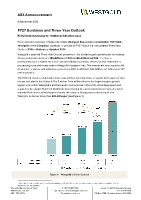

SOURCE Westgold Resources Limited